





Corporate Governance

Corporate Governance Policy

bg-governance-01
img-governance-01
bg-governance-01
img-governance-01
Corporate Governance Policy
1.
Corporate Governance Policy
Vision
“UFM, the Leader in Quality Wheat Flour products for Health and Food Security”
Missions
“Every bag of UFM flour is quality and reliable”
Determination
“People must consume wheat flour-based foods with great nutritional content
at a reasonable cost and with quality standards equivalent to those of other countries”
Values
Professionalism
Innovativity
Empathy
Synergy
Corporate Identity
Expertise
Empathy
Innovative

Objectives

The Board of Directors has the intention to promote United Flour Mill Public Company Limited (the “Company”) as an organization that operates with efficiency, sound management practices, business ethics, and a management system that is transparent, auditable, equitable, and fair. This is to ensure the Company's sustainable growth and to maximize benefits for the Company while fostering confidence and building strong relationships with the Company's stakeholders.
The Board of Directors has established a Corporate Governance Policy in accordance with international corporate governance standards,
to serve as a framework for the Board of Directors, senior management, and all personnel of the Company to follow in their conduct.
The Policy is composed of five chapters,
as follows:
Section 1
Rights of Shareholders
Section 2
Equitable Treatment of Shareholders
Section 3
Role of the Stakeholders
Section 4
Disclosure and Transparency
Section 5
Responsibilities of the Board of Directors

Scope of Application

This Corporate Governance Policy applies to the Board of Directors, the chief executives and the personnel in all units of the Company.

Definitions

TermsMeaning
Board of DirectorsCompany’s Board of Directors.
Sub-committee(s)Sub-committees appointed by the Board of Directors as to support the Board of Directors’ performance of duties as necessary, such as the Executive Committee, Audit Committee or Nomination and Remuneration Committee, etc.
CompetitorsA group of individuals or institutions engaged in the same or similar business activities, whose products or services are substitutable or interchangeable from the perspective of customers.
PartnersAny suppliers of goods and/or services to the Company
CreditorsA person or legal entity entitled to demand payment from the Company for debts arising in the ordinary course of business, whereby the Company is obligated to make payment for goods and services upon the agreed due date.
Personnel of the CompanyEmployees at all levels working for the Company
ShareholdersCompany’s shareholders
Chief ExecutivesPerson who take the position of Chief Executive Officer or Chief Financial Officer
StakeholdersShareholders, customers, competitors, partners, debtors, creditors, personnel of the Company, government or government agencies, Society and communities, individuals, legal entities involved directly and affected by the operations of the Company
CustomersPurchaser or user of the Company’s services
DebtorsIndividual or legal entity who the Company has the right to demand for debt payment whether in cash, asset, action, or other economic benefits when payment is due
Secretary of the meetingCompany’s secretary
RegulatorGovernment sector as well as government agencies or companies related to the government that have a duty to supervise other companies to comply with the law or according to their authority

Guidelines on Good Governance

Good Governance means the structuring and implementation of governance frameworks and mechanisms that define and regulate the relationships and decision-making processes among the Board of Directors, senior management, Company personnel, shareholders, and other stakeholders, in order to achieve the objective of creating long-term sustainable value for the Company.
Guide of Practices under the Good Governance Principles
Section 1
Rights of Shareholders
1)
Rights to sell or transfer shares and right to profit sharing
The Company places great importance on the protection and preservation of shareholders' rights, recognizing shareholders as the rightful owners of the Company who exercise control through the Board of Directors appointed by them. Accordingly, the Board of Directors acknowledges the importance of granting fundamental rights to all shareholders in an appropriate, equitable, and fair manner. Such fundamental rights of shareholders include, among others, the right to buy and sell shares, the right to transfer shares, and the right to receive a portion of the Company’s profits. The portion of profits allocated to shareholders shall be distributed as returns in accordance with the Company’s dividend payment policy.
2)
Rights to receive information, attend meetings and cast votes in the meeting of Shareholders
Shareholders, as owners of the Company, are entitled to attend meetings, propose meeting agenda items in advance, nominate individuals for election as directors, and participate in decision-making on matters of material significance to the Company. These include the approval of major transactions that affect the Company’s business direction, the exercise of voting rights either in person or by proxy, the receipt of meeting invitations, and the right to receive and access information of the Company. Each year, the Company shall convene meetings in strict compliance with applicable laws, the Company’s Articles of Association, and its Good Corporate Governance Policy. The conduct of such meetings shall adhere to the following prescribed procedures and principles:
2.1)
Prior to the Shareholders’ Meeting
A.
The Board of Directors shall convene an Annual General Meeting of Shareholders within a period not exceeding four (4) months from the end of the Company’s fiscal year. Any shareholders’ meeting held other than the aforementioned shall be referred to as an Extraordinary General Meeting.
B.
The Board of Directors may convene an Extraordinary General Meeting of Shareholders at any time as it deems appropriate. Alternatively, shareholders holding not less than one-fifth (1/5) of the total number of issued shares, or not less than twenty-five (25) shareholders holding in aggregate not less than one-tenth (1/10) of the total number of issued shares, may jointly submit a written request to the Board of Directors to convene an Extraordinary General Meeting of Shareholders at any time, provided that the request clearly states the reasons for calling such meeting. In such case, the Board of Directors shall convene the shareholders’ meeting within one (1) month from the date of receipt of the said request.
C.
In calling a shareholders’ meeting, the Board of Directors shall prepare a notice of meeting along with supporting documents and assign Thailand Securities Depository Co., Ltd., a securities registrar, to deliver such notice of meeting to all shareholders in advance within the period prescribed by applicable laws and the Company’s Articles of Association. The notice of meeting shall clearly specify the venue, date, and time of the meeting, the agenda items, the objectives and rationales for each agenda item, the opinion of the Board of Directors, the voting requirements for each item, and all other relevant supporting information in a sufficiently detailed manner to allow shareholders adequate time to review and consider the information in advance of the meeting. In cases where additional agenda items are proposed by shareholders in accordance with applicable laws, the Company shall publish the notice of meeting in a newspaper for a consecutive period of not less than three (3) days, and such publication shall be made at least three (3) days prior to the date of the meeting.
D.
The Company allows the shareholders to authorize a proxy to attend the meeting on their behalf. The Company will prepare a proxy appointment form in accordance with the laws along with instructions on how to appoint a proxy and deliverer to the shareholders together with the invitation notice for the shareholders to be able to authorize other person as proxy to attend the meeting on their behalf. The rules, procedures and conditions for proxy appointment will be in accordance with the legal requirements.
E.
The shareholders may propose meeting agenda and/or nominate persons to be appointed as directors in the annual general meetings of shareholders. The shareholders may also submit their queries, suggestions and opinions in advance of the general meeting of shareholders. The said can be done through several channels such as by e-mail and by post.
2.2)
Conduct of the Shareholders’ Meeting
A.
The shareholders’ meeting shall be convened at a venue or conducted through electronic means that are appropriate to the number of participants, ensure a high standard of security, and provide convenience for shareholders to attend. Such arrangements must be in full compliance with all applicable laws and regulations. The physical location of the shareholders’ meeting shall be within the locality in which the Company’s head office is situated, or at such other location as may be determined by the Board of Directors. In all cases, the Company shall strictly comply with public health measures prescribed by the Ministry of Public Health for the prevention and control of disease outbreaks.
B.
A shareholder registration process shall be arranged using pre-printed registration forms and proxy forms bearing the names of each shareholder, applicable to both physical meetings held at the designated venue and electronic meetings. This is to ensure an efficient and expedited registration procedure. In addition, stamp duties shall be prepared and made available for participants attending the meeting by proxy on behalf of shareholders.
C.
Guidelines for the conduct of the meeting shall be established to ensure that all shareholders are treated equally and are provided with appropriate facilitation. Shareholders shall be permitted to register and attend the meeting at any time during its course, and shall be entitled to exercise their voting rights on any agenda item for which a resolution has not yet been passed. Shareholders shall also have the right to freely and equally express their opinions on such agenda items within an appropriate timeframe.
D.
Prior to the commencement of the meeting, the Chairperson or a designated representative shall introduce the attending directors, executives, auditor, and legal advisor (if any), and inform the meeting of the voting procedures and vote counting method. After each agenda item is presented, the Chairperson shall allow shareholders to ask questions and express opinions equally. Appropriate time shall be allocated for discussion and responses. For the election of directors, shareholders shall vote on an individual basis.
E.
Ballot cards shall be used for voting, and the Company shall appoint responsible officers to verify and count the votes for each agenda item. Upon the completion of voting on each item, the officers shall collect the ballots, tally the votes, and promptly disclose the results to the meeting. All ballots shall be categorized and securely retained for each respective agenda item.
F.
Shareholders who attend the meeting after it has been called to order by the Chairperson shall be entitled to vote on agenda items that are under consideration and for which no resolution has been adopted. Such shareholders shall be counted as part of the quorum only from the agenda item at which they are present onward. Consequently, the quorum and the number of shareholders eligible to vote may vary across agenda items.
G.
In the meeting, if any shareholder has a direct or indirect interest or conflict of interest in any agenda item, such shareholder shall disclose the matter to the meeting, abstain from voting, and refrain from participating in the deliberation of that item. The meeting shall record the relevant details and facts in the minutes accordingly.
2.3)
Subsequent to the Annual General Meeting
A.
The Company shall submit the annual report, together with copies of the audited statement of financial position and statement of comprehensive income as approved by the shareholders, as well as a copy of the minutes of the shareholders’ meeting relating to the approval of such financial statements, profit appropriation, and dividend distribution. These documents shall be certified as true and correct by an authorized signatory of the Company and submitted to the Registrar. The statement of financial position and statement of comprehensive income shall also be published in a newspaper for at least one (1) day following the date of such publication. All such submissions and publication shall be completed within one (1) month from the date of the shareholders’ approval. In addition, the Company shall update and submit its current shareholder register to the Registrar of Public Limited Companies in accordance with the law.
B.
The Company shall prepare and retain the minutes of the shareholders’ meeting and the resolutions thereof at the Company’s office. Any shareholder wishing to inspect the minutes or resolutions may submit a written request or contact the Company at 02-225-3227 ext. 1556, addressed to the Company Secretary or the Legal Department, who shall act as the liaison for disclosure and direct communication with shareholders.
Section 2
Equitable Treatment of Shareholders
The Company places importance on all shareholders, including directors, senior executives, employees, minority shareholders, and foreign shareholders. It adheres to governance practices that protect the fundamental rights of shareholders equally and fairly, thereby promoting investor confidence. The Company also provides shareholders with the right to propose agenda items and to nominate qualified candidates for election as directors.
The Company has established measures governing the use of internal information and has clearly communicated such measures to directors, senior executives, and employees. The use of material non-public information for personal gain or for the benefit of others is strictly prohibited. Such conduct shall be considered a serious violation and subject to disciplinary action.
In addition, all directors and executives of the Company are required to disclose their interests, as well as those of related persons, in accordance with the criteria and procedures prescribed by the Company and applicable laws. This enables the Board of Directors to consider transactions that may involve conflicts of interest and to make decisions in the best interest of the Company as a whole. Any director or executive who has an interest in a transaction with the Company shall not participate in the decision-making process related to such transaction.
Section 3
Role of Stakeholders
The Company recognizes the significance of all stakeholder groups, including shareholders, customers, competitors, business partners, debtors, creditors, employees, government authorities, society, and local communities. These stakeholders are entitled to fair treatment and protection in accordance with applicable laws, with a view to achieving sustainable and inclusive growth. Accordingly, the Company has adopted a comprehensive framework of ethical standards and governance policies, including the Code of Business Ethics, the Code of Conduct for Directors, Advisors, and Executives, and the Employee Code of Conduct. These instruments serve as operational guidelines to ensure that all Company personnel act responsibly and equitably toward stakeholders, upholding their rights and legitimate interests.
1)
Shareholders
The Company operates its business through knowledgeable and competent personnel, with transparency, integrity, and fairness, in compliance with all applicable rules, regulations, and laws. Its objective is to ensure stable and sustainable growth while maximizing returns to shareholders. The Company is committed to accurate and equitable disclosure of information through various communication channels.
2)
Customer
Customers are the most important group enabling the Company's business operations, providing revenue that supports management expenses, generates profit, and contributes to the sustainability of the enterprise. Therefore, senior management and all personnel are expected to treat customers fairly in order to foster satisfaction and long-term trust. The Company adheres to the following principles:
2.1)
Offer products or services at fair prices, with profit margins that are reasonable in relation to the quality offered, and ensure accuracy in quantity, quality, and price as agreed.
2.2)
Treat and serve all customers equally, ensuring equal opportunity to purchase products and receive services under all circumstances.
2.3)
Refrain from any conduct that influence customers’ purchasing decisions by leveraging the Company’s superior position, imposing reciprocal obligations, or creating coercive conditions requiring compliance
2.4)
Refrain from any action that causes product prices to rise without legitimate justification.
2.5)
Treat customers with courtesy and goodwill, provide services in a respectful manner, and safeguard customer confidential information.
3)
Competitors
As Competition drives economic progress and benefits consumers, the presence of competitors encourages continuous improvement in the quality of products and services. Senior management and all personnel shall treat competitors fairly and ethically, in accordance with the following principles:
3.1)
Avoid dishonest practices intended to harm competitors, and do not seek to obtain trade secrets through unlawful means or by breaching confidentiality agreements.
3.2)
Conduct business professionally within a framework of fair competition.
3.3)
Cooperate in fostering a healthy market environment through fair competition, such as by providing accurate product or service information and developing new and innovative offerings.
4)
Partners
The Company is committed to treating all business partners equitably, in accordance with fair, transparent, and honest commercial practices. It upholds mutual respect for the rights of all parties and does not allow personal judgment or relationships to influence business decisions, to be in line with the Company’s Partner Policy as follows:
4.1)
Do not solicit or accept any assets or benefits from business partners, refrain from purchasing goods from partners who violate intellectual property rights or human rights, and do not engage in business with partners involved in unlawful activities.
4.2)
Refrain from exercising commercial leverage through reciprocal arrangements or coercive conditions, and uphold honesty and integrity in all business dealings.
5)
Debtors
The Company shall strictly adhere to the rights, obligations, and conditions applicable to debtors as specified in the relevant transactions, agreements, or contracts, in a fair and lawful manner.
6)
Creditors
The Company operates under commercially reasonable conditions and in accordance with industry practices. It complies with trade terms and contractual obligations in an equitable and fair manner, and conducts business with honesty and integrity to foster trust and fairness toward creditors.
7)
Personnel of the Company
The Company’s personnel are a key factor in its business operation and a valuable resource for its business. Having good, capable, diligent and honest personnel will make an efficient and successful business. The Company encourages the personnel to improve their knowledge and capability and work efficiently together for as long as possible. The Company’s personal should be treated equitably and fairly based on the following principles:
7.1)
Establish compensation standards that align with the Company’s performance, ensuring that wages and benefits are commensurate with employees’ competencies and job responsibilities, including the provision of rewards when the business achieves increased profitability.
7.2)
Establish performance evaluations based on key performance indicators (KPIs) that reflect the achievement of work objectives.
7.3)
Provide employee welfare that meets personnel needs, with a focus on workplace conditions, hygiene, and overall well-being. Ensure that workspaces and meeting rooms are modern, well-equipped, and convenient for use. Promote team-building activities and unity among employees. The Company shall also provide appropriate protective equipment to prevent work-related hazards, care for employees who fall ill, and ensure the availability of basic medical supplies and first aid in accordance with legal requirements.
7.4)
Ensure adequate, consistent, and transparent disclosure of any changes that may significantly impact employment, employee welfare, or staff morale.
7.5)
Support and provide training and development opportunities to enhance employees’ knowledge, skills, and experience, enabling them to fully understand and perform their duties effectively.
7.6)
Respect the individual rights and capabilities of employees, including the use, storage, and protection of their personal data in compliance with personal data protection laws.
7.7)
Encourage employees to be responsible citizens and to actively contribute to society.
7.8)
Establish a clear job structure that provides defined career advancement pathways.
7.9)
The Company provides grievance channels for employees and establishes procedures for handling complaints, including measures to protect whistleblowers.
8)
Government or governmental agencies
The government or governmental agencies are essential institutions within society, which all citizens inevitably interact. Accordingly, senior management and employees of the Company are expected to engage with government authorities in a manner that upholds public order and complies with the rule of law, as outlined below:
8.1)
Cooperate with government authorities in fulfilling civic duties and conduct all transactions with honesty and integrity.
8.2)
Comply with all legal requirements relating to business operations, accounting, and taxation in accordance with the nature of the business, and do not enable or support any misconduct by government officials in connection with the Company’s business activities.
8.3)
Refrain from offering bribes to government agencies for the purpose of obtaining any business advantage.
8.4)
Refrain from cooperating with or supporting any actions by government officials undertaken with corrupt intent, in any form whatsoever.
8.5)
Refrain from offering gifts or gratuities to government officials, except on customary occasions and only where the value is appropriate and does not exceed the limit specified by the law.
8.6)
Cooperate with government authorities in fulfilling civic duties and provide support in areas that benefit society and the community.
8.7)
Maintain a respectful and trusting attitude toward government authorities, without prejudice or intentional avoidance of engagement.
9)
Society and community
As members of society are varied in terms of status, occupation, religion, ethnicity, and beliefs, peaceful and harmonious coexistence requires mutual understanding and cooperation among all individuals. In this regard, the Board of Directors, senior management, and all employees of the Company have a responsibility to contribute to the development of a just and progressive society. To this end, the following principles shall be practiced:
9.1)
Refrain from engaging in any business activities that contribute to social degradation, whether moral or spiritual, which may undermine individual well-being and promote misguided values within society.
9.2)
Refrain from any actions that may cause harm to natural resources or the environment. Support and cooperate with activities and comply with relevant government policies aimed at the conservation of natural resources, the environment, and society.
9.3)
Pay attention to the business operations to prevent causing pollution or any adverse impact on the environment and society.
9.4)
Respect the intellectual property rights of others and other businesses. Do not copy ideas or reproduce products without proper authorization.
9.5)
Cooperate with all parties in the society to improve the society by sacrificing time, labor and financial resources that are appropriate to the Company.
9.6)
Place importance on creating employment opportunities for local communities in alignment with their capabilities, thereby supporting both sustainable business growth and the development of a quality society.
Section 4
Disclosure and Transparency
The Company upholds a policy of disclosing material information accurately, completely, transparently, and in a timely manner through accessible, equitable, and reliable channels, as follows:
1)
Prepare and disclose the annual report, copies of the statement of financial position, and the comprehensive income statement in accordance with generally accepted accounting standards and duly audited by a certified public accountant, including performance reports and other material information and reports.
2)
Prepare a report on the corporate governance policy as approved by the Board of Directors, together with a report on the implementation of such policy.
3)
Disclose the names, roles, and responsibilities of the Board of Directors and its sub-committees, the number of meetings held, and each director’s attendance record over the past year, including any comments or opinions from sub-committees in the annual report (as necessary and appropriate).
4)
Regularly review disclosure and transparency policies to ensure alignment with applicable laws, regulations, and current legal requirements.
Section 5
Board of Directors’ Duties
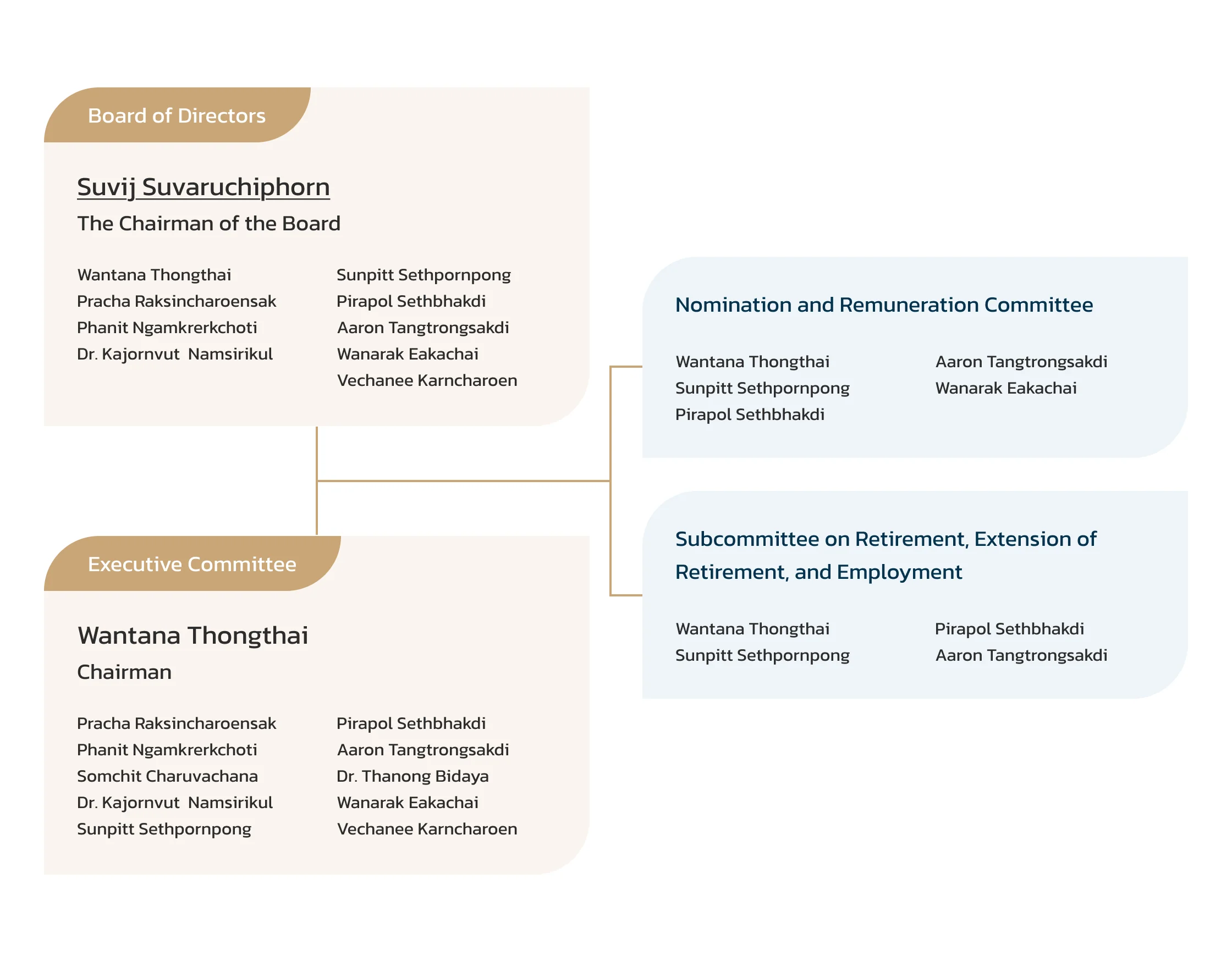
The Company has established a corporate structure in accordance with the principles of good corporate governance, comprising a Board of Directors that acts as a representative responsible to the shareholders. The Board plays a supervisory role in ensuring that the Company operates in compliance with applicable laws, its objectives, Articles of Association, and resolutions of the shareholders’ meetings. The Board may, as necessary, appoint an Executive Committee and/or sub-committees to oversee key business functions. These may include the Audit Committee, the Nomination and Remuneration Committee, the Executive Committee, the Investment Committee, among others. In addition, the Company has appointed a Company Secretary to coordinate and provide legal and regulatory guidance to the Board of Directors.
1.
Composition, qualifications and appointment of the Board of Directors
The Board of Directors has the role, duties, and responsibilities to oversee the Company’s management, including the formulation of strategies, vision, policies, goals, and missions that aim to maximize shareholder value. The Board is also responsible for monitoring the implementation of such strategies and ensuring fair treatment of all stakeholders.
1.1)
The composition of the Board of Directors is as follows:
A.
The Board of Directors comprises individuals of integrity, ethical standards, knowledge, expertise, and experience across various professional fields which are useful to the Company’s business operation without any discrimination against sex.
B.
The number of directors shall be as prescribed in the Articles of Association as approved by the shareholders’ meeting, and shall not be fewer than five (5) but not exceed thirty (30) persons. No less than half of the total number of directors must be residents of the Kingdom of Thailand.
C.
There shall be at least one independent director on the Board.
D.
The Board of Directors shall elect one of its members to serve as the Chairman of the Board. If deemed appropriate, the Board may also elect one or more members to serve as Vice Chairman(s).
1.2)
The qualifications of Directors, their appointment and term of office are as follows:
1)
The Directors must possess qualifications that do not conflict with the Public Limited Companies Act B.E. 2535, as well as other applicable laws and the Company’s Articles of Association.
2)
The Director shall not be a partner, director, or shareholder of any other legal entity that operates a business in competition with the Company or in a manner that may result in a conflict of interest, unless such information has been disclosed to the shareholders’ meeting prior to the resolution on the appointment.
3)
The Directors shall possess integrity, ethics, vision, knowledge, experience, and other qualifications that are in the best interest of the Company’s operations, and be able to devote sufficient time to fully perform their duties.
4)
The appointment of the Directors shall be conducted through a transparent and clearly defined process, whereby nominations are proposed for approval at the shareholders’ meeting.
5)
Resumes and details on positions of all the Directors shall be disclosed to the shareholders prior to the shareholder’s meeting.
1.3)
The qualifications and appointment of independent directors are as follows:
1)
The independent directors must be independent from the major shareholder(s) and the management of the Company and must have all of the required qualifications based on the rules prescribed by the Securities and Exchange Commission including other relevant laws (mutatis mutandis).
2)
The independent directors must be able to dedicate their time to attend the meetings of the Board of Directors and must provide their opinions independently.
3)
The appointment of independent director(s) must be done through a nomination to the Board of Directors for consideration before proposing ones to the meeting of shareholders for appointment.
1.4)
Term of office
The term of office of directors is prescribed in compliance with the applicable laws and the Company’s Articles of Association. At each Annual General Meeting of Shareholders, one-third (1/3) of the directors shall retire by rotation. If the number of directors is not a multiple of three, the number nearest to one-third shall retire. The Directors holding office for the longest period shall be the ones who retire first. A retiring director is eligible for re-election and may be re-appointed by receiving more than half of the votes of the shareholders present and entitled to vote.
2.
The independency of the Board of Directors
The Company has established a system of checks and balances to ensure that management operates in full compliance with regulations, the Company’s Articles of Association, and established practices, in an efficient and transparent manner, as follows
2.1)
The Company has established a clear separation of its corporate structure, roles, powers, duties, and responsibilities among the Board of Directors, which comprises executive directors, independent directors, and non-executive directors, in order to ensure effective checks and balances and oversight within the organization.
2.2)
Independent director is an individual who is independent from the Company's management and has sufficient access to financial and business information to express opinions independently, in order to protect the interests of shareholders and other stakeholders.
3.
The role and duties of the Board of Directors (10 rules)
The Board of Directors holds the role, duties, and responsibilities of driving and overseeing the Company’s operations to ensure long-term sustainable performance and credibility for shareholders and stakeholders. To this end, the Board has established a set of governance principles to serve as a framework for good corporate governance, comprising the following ten principles:
Rule 1
Lay out visions and strategies to set the Company’s strategic direction.
Rule 2
Recognize the Board’s role and responsibility as the leadership body in delivering sustainable value to the Company.
Rule 3
Determine the Company’s objectives and core goals with a focus on long-term sustainability.
Rule 4
Strengthen the effectiveness of the Board of Directors.
Rule 5
Recruit and develop top chief executives and manage human resources.
Rule 6
Promote innovations and operate business responsibly.
Rule 7
Ensure the implementation of appropriate risk management and internal control system.
Rule 8
Maintain financial credibility and transparency in disclosure.
Rule 9
Encourage participation and communications with the shareholders.
Rule 10
Encourage responsibilities to the society and the environment.
The principles of good governance, emphasizing the roles and responsibilities of the Board of Directors, are intended to serve as a guideline for the Board in overseeing the Company’s governance. These principles are as follows:
3.1)
Rule 1 Lay out visions to set the Company’s strategic direction
Strategy is a critical tool for the Company to achieve its objectives and goals. Strategies at each level define the direction of the Company’s future growth. Therefore, the Board of Directors should play an active role and bear the responsibility for formulating strategies that enable the Company to remain competitive within the industry, including the following areas:
1)
Corporate Level: This refers to the vision and mission that guide senior management and employees in understanding the overall business direction of the Company, as well as the core values the Company aims to uphold or create to ensure long-term success.
2)
Business Level: This involves translating the Company's vision and mission into specific strategies for each of its business units. These strategies may include market expansion, market share growth, market development, product development, and diversification into new businesses. The aim is to identify and implement the most appropriate business strategies according to prevailing market conditions.
3)
Functional Level: This refers to the development of operational strategies within key functional areas such as marketing, production, finance, and human resources, to support the implementation of the Company’s overall business strategy.
3.2)
Rule 2 Recognize the Board’s role and responsibility as the leadership body in delivering sustainable value to the Company.
A.
The roles and responsibilities as the leader to supervise for good governance of the Company
(1)
Establish the Company’s objectives and targets/goals:
The Board of Directors is responsible for defining the Company’s business objectives, core goals, vision, and mission. The Board shall ensure effective communication of these elements to all employees, fostering a shared understanding and unified direction in operations. This collective commitment is aimed at driving the Company toward sustainable value creation—economically, socially, and environmentally—while taking into account the interests of all stakeholder groups.
(2)
Establish policies, strategies and operations as well as allocate important resources for the objectives and the targets/goals to be achieved as well as monitor, evaluate and take care of the operating result reports:
The Board of Directors jointly establishes and regularly reviews the Company’s policies, operational plans, and budgets to ensure alignment with the overall business direction. The Board also monitors and evaluates performance on an ongoing basis, taking into account competitive capabilities, industry trends, technological developments, and both short- and long-term business impacts. The objective is to provide guidance to management for continuous improvement and adaptation, enabling the Company to enhance performance and respond effectively to changing circumstances.
B.
Creating sustainable values for the Company
The Board of Directors encourages the establishment of comprehensive corporate governance and ethical conduct policies at the Company, Board, executive, and employee levels, to serve as guiding principles in performing duties with responsibility, prudence, and integrity, without creating conflicts of interest or misconduct toward shareholders or other stakeholders. The Board also upholds itself as a role model in corporate governance leadership, with due regard to the interests of society and the environment.
Furthermore, the Board conducts itself as a role model in promoting good corporate governance by ensuring the communication of corporate governance and ethical conduct policies so that directors, senior executives, and employees of the Company have sufficient understanding to facilitate effective implementation. The Board shall ensure the establishment of operational processes that enable the consistent monitoring of compliance and performance.
C.
Performance of Duties with Responsibility, Prudence, and Integrity Toward the Company; Conducting Operations in Compliance with Laws, the Articles of Association, and Resolutions of the Shareholders’ Meeting
The Board of Directors shall perform its duties in ensuring that all directors and senior executives carry out their responsibilities with responsibility, prudence, and integrity toward the Company, and shall ensure that the Company’s operations comply with applicable laws, the Articles of Association, and resolutions of the shareholders’ meeting. This includes ensuring the establishment of an appropriate, adequate, and reliable financial reporting, accounting, and internal control system to support operations that are complete and accurate, safeguard the interests of shareholders and all stakeholder groups, and ensure the disclosure of information that is accurate, complete, and timely.
D.
Clear Definition of the Scope of Delegation of Duties and Responsibilities to Management, and Establishment of Mechanisms for Monitoring Management Performance in Accordance with Such Delegation
(1)
The Board of Directors has the duty to establish an Audit Committee to review and ensure that the Company maintains an effective and independent internal control system and internal audit system.
(2)
The Board of Directors may appoint directors and/or executives as the Executive Committee to perform any act or several acts on behalf of the Board of Directors, provided that such delegation of authority remains within the scope of the Board of Directors’ authority. The Board may also appoint various sub-committees as necessary and appropriate to support the Board in the performance of its duties. The Board shall have the authority to amend or revise the scope of authority and duties as necessary or appropriate.
(3)
The Board of Directors shall establish the Board Charter, the Executive Committee Charter, and charters of other sub-committees. Such charters shall define the scope, delegation of duties, and responsibilities of the Board to be used as reference in the performance of duties by directors. The Board shall regularly review, at least once a year, the division of roles and responsibilities between the Board and management to ensure alignment with the Company’s direction, objectives, Articles of Association, Board resolutions, shareholders’ meeting resolutions, and applicable laws.
3.3)
Rule 3 Establishing Objectives and Key Goals of the Business for Sustainable Outcomes
The Board of Directors has jointly established and reviewed the Company’s vision, mission, and business strategies, and supervises the Company’s operations to ensure alignment with the prescribed objectives and goals so as to maximize economic value for the Company and its shareholders. The Board has also set clear short-term and long-term business objectives, established concrete operational frameworks and annual plans, taking into account economic conditions, market competition, risk factors, and past operating performance. The Board monitors the Company’s operations to ensure achievement of the set objectives, thereby creating value for the Company, customers, stakeholders, and society at large, while strengthening stakeholders’ confidence through the exercise of independent judgment, refraining from seeking benefits for themselves or any particular person, and avoiding any act that conflicts with or competes against the Company’s interests. Furthermore, the Board adopts and applies appropriate and safe modern innovations and technologies based on social and environmental responsibility, and is committed to leading the Company forward on a continuous path towards sustainability.
3.4)
Rule 4 Strengthening an Effective Board of Directors
A)
The Board of Directors recognizes its essential role in governing the Company for its utmost benefit and understands its roles, duties, and responsibilities, including the delineation of responsibilities between the Board and the management of the Company. The Board ensures that the Company maintains credibility in its operational systems and transactions by operating in compliance with the law and ethical standards. To ensure the effectiveness and efficiency of the Board’s performance, the Board jointly determines and reviews the Board structure, selects individuals with appropriate knowledge and qualifications to serve as directors, and considers directors’ remuneration for submission to the annual general meeting of shareholders.
B)
The Board shall select a qualified individual to serve as Chairman of the Board and ensure that the Board’s composition and operations facilitate the exercise of independent judgment in decision-making towards achieving the Company’s established objectives and goals. The duties of the Chairman of the Board shall include the following:
(1)
overseeing, monitoring, and ensuring that the Board’s performance is effective and aligned with the Company’s objectives and primary goals;
(2)
ensuring that all directors participate in fostering an ethical corporate culture and good corporate governance;
(3)
determining the agenda items for Board meetings in consultation with management and implementing measures to ensure that important matters are included on the meeting agenda;
(4)
allocating sufficient time for management to present matters and for directors to thoroughly discuss key issues;
(5)
fostering good relations between executive directors and non-executive directors, as well as between the Board and management;
(6)
presiding over Board meetings to ensure efficient conduct in accordance with the Company’s articles of association, and supporting and facilitating the expression of independent opinions by directors;
(7)
serving as the chair of Board meetings, overseeing the meetings, and casting a deciding vote in the event of a tie vote at a Board meeting; and
(8)
serving as the chair of shareholders’ meetings and presiding over such meetings.
C)
The Board of Directors oversees the establishment of transparent and clearly defined criteria and procedures for the nomination and selection of directors, and maintains policies and criteria for determining directors’ remuneration, in order to ensure that the Board comprises individuals whose qualifications provide the Board with an appropriate composition of knowledge and expertise. The Board shall also review the background of such individuals and provide its opinion to the Board prior to proposing their appointment to the shareholders’ meeting for consideration. In addition, the Company shall disclose information of the nominated individuals to the shareholders to support their decision-making, and shall review the criteria and procedures for director nomination and provide recommendations to the Board prior to the nomination of directors whose terms have expired.
In determining the remuneration of the directors and the Board committees, the Board shall review the appropriateness and alignment of such remuneration with the duties, performance, and responsibilities assigned, including the directors’ performance in achieving the objectives, goals, and business direction established by the Company, prior to proposing the matter to the shareholders’ meeting for approval. In determining directors’ remuneration, the Board shall also take into consideration comparative references to companies within similar industries and businesses.
D)
The Board shall establish and regularly review the framework and mechanisms for overseeing the Company’s policies and operations and/or the operations of any other businesses in which the Company has made significant investments.
E)
The Board shall require that the Company’s internal systems and processes be reviewed in accordance with the COSO framework (The Committee of Sponsoring Organizations of the Treadway Commission) and shall employ a risk management system as a tool in its operations. An assessment of the adequacy of the internal control system shall be conducted annually, including the preparation of a systematic information system contingency plan to prevent or mitigate incidents that may cause damage to the Company’s business operations, thereby ensuring business continuity. The Board shall focus on safeguarding security, compliance with applicable laws, regulations, or relevant agreements, as well as ensuring the accuracy of information and preserving the Company’s image and credibility.
F)
The Board, the Board Committees, and individual Directors shall conduct an annual performance evaluation at least once per year. Both the collective and individual evaluations shall be performed through a self-evaluation method (Self-Evaluation), and a summary of the evaluation results shall be reported to the shareholders’ meeting to acknowledge the performance and issues identified. The conclusions from such evaluations shall be used to improve the performance of the Board. The Company shall disclose the evaluation criteria, procedures, and overall results in the annual report.
3.5)
Rule 5 Selection and Development of Senior Executives and Personnel Management
The Board recognizes the importance of personnel at all levels who assume positions within the Company and contribute to driving the Company toward its objectives. Accordingly, the Board oversees that the selection and development of executives at all levels are conducted appropriately and transparently, taking into consideration knowledge, skills, and experience, prescribing suitable remuneration and evaluations, and overseeing that personnel management and development are aligned with the Company’s direction and strategy.
A)
Selection and Appointment of Senior Executives
The Board oversees the selection of personnel by screening individuals who are fully qualified, suitable, and possess an understanding of the shareholding structure and relationships that may affect management, as well as expertise in the Company’s business and the capability to lead the Company forward. Such individuals must also exhibit leadership qualities and must not have any improper behavior. The remuneration of senior executives shall fall within the framework approved by the Board of Directors and shall be aligned with the Company’s performance and the individual performance of each senior executive for the utmost benefit of the Company.
B)
Succession Plan for Senior Executives
The Board is responsible for ensuring that the Company prepares a succession plan for senior executive positions to maintain the confidence of shareholders, the Company, and its personnel that the Company’s operations will continue without interruption.
C)
Personnel Development
The Company promotes and facilitates continuous training and knowledge enhancement for the Board of Directors, Board Committees, executives, and the Company Secretary in order to cultivate knowledge and new perspectives applicable to their duties, consistent with the Company’s ongoing business operations, as follows:
(1)
Whenever there is a change in Directors, the management or the Human Resources Department shall arrange an orientation for all newly appointed Directors and provide documents and information useful for the performance of their duties, such as the Board Charter, the Corporate Governance Policy, the Code of Conduct, the Articles of Association, the shareholding structure, the Company’s performance, relevant rules or laws, as well as an introduction to the Company’s business nature and operating approach. This is intended to enhance the knowledge and understanding of newly appointed Directors regarding the Company’s business and its various operations
(2)
The Company encourages Directors and executives to attend training courses relating to good corporate governance organized by reputable training providers, such as the Thai Institute of Directors Association (IOD), the Office of the Securities and Exchange Commission, and the Stock Exchange of Thailand, among others.
3.6)
Rule 6 Promotion of Innovation and Responsible Business Operations
The Board places importance on fostering a corporate culture that promotes innovation and ensures that management incorporates such culture into its review of strategies, operational development and improvement planning, and performance monitoring, in order to enhance corporate value in light of continuously changing environmental factors. This includes determining the business model, objectives, and goals, with consideration of the shared interests of all stakeholder groups, including the Company, customers, business partners, society, and the environment. The Board also oversees the establishment and review of various policies to ensure that Directors, senior executives, and Company personnel strictly comply therewith, such as the Corporate Governance Policy and the Risk Management Policy.
3.7)
Rule 7 Ensuring Appropriate Risk Management and Internal Control Systems
The Board recognizes its duties to ensure that the Company maintains risk management and internal control systems that enable the achievement of its objectives effectively and in compliance with relevant laws and standards, guided by the following:
A)
Establishment of an Audit Committee, all of whom shall be Independent Directors possessing qualifications and duties as prescribed under the criteria of the Office of the Securities and Exchange Commission and the Stock Exchange of Thailand. The Board assigns the Audit Committee to have access to the information necessary to perform its duties, as follows:
(1)
Reviewing that the Company maintains accurate financial reporting;
(2)
Reviewing that the Company maintains appropriate and effective internal control and internal audit systems;
(3)
Reviewing that the Company complies with applicable laws and relevant standards;
(4)
Considering related-party transactions or transactions that may give rise to conflicts of interest, with reference to the Securities and Exchange Act, the regulations of the Stock Exchange of Thailand, the Revenue Department’s rules, and other applicable laws, to ensure that such transactions are reasonable and in the best interests of the Company;
(5)
Reporting assessments of the internal control system, risk management, and follow-up results to the Board at least four times per year.
B)
The Board oversees that the Company maintains an appropriate risk management system by establishing a clear Risk Management Policy and directing senior executives and Company personnel to assess risks, evaluate impacts and the likelihood of occurrence, prioritize risks, and determine appropriate risk mitigation methods for reporting to the Board.
C)
The Board monitors, oversees, and manages related-party transactions or transactions that may give rise to conflicts of interest between the Company and management, Directors, or shareholders, including preventing improper use of the Company’s assets, information, and business opportunities, as well as preventing inappropriate transactions with related parties, as follows:
(1)
Establishing and reviewing the policy on related-party transactions or transactions that may give rise to conflicts of interest, referencing the Securities and Exchange Act, the Civil and Commercial Code, the Revenue Department’s rules, and other applicable laws;
(2)
Assigning the Audit Committee to review and report such matters to the Board.
D)
Considering the establishment of clear anti-corruption policies and practices and communicating them at all levels of the Company to ensure that Directors, senior executives, and personnel adhere to and implement such policies.
E)
Overseeing the establishment of guidelines and channels for receiving complaints regarding unlawful acts, violations or non-compliance with the Code of Conduct, violations of human rights, or behaviors suggestive of corruption committed by individuals within the Company, whereby whistleblowers may choose to remain anonymous without disclosing their name, address, or contact number, with due regard to their safety and potential harm, and ensuring that the Company publicly discloses its whistleblowing and complaint channels on its website.
Postal Mail:
Chairman of the Executive Committee
United Flour Mill Public Company Limited
No. 177, 205, 9th Floor, Ratchawong Road,
Chakkrawat Sub-District, Samphanthawong District, Bangkok 10100
Telephone:
02-2253227extension to the Internal Audit and Risk Management Department
The Company also ensures oversight of the complaint-handling process, including documentation, monitoring progress, resolving issues, and reporting in a clear manner.
F)
Exercising due care in the use and protection of confidential customer information, ensuring that such information is not used for the benefit of Directors, senior executives, Company personnel, or related persons, except where disclosure is required by law.
The Company also places importance on data security within its information systems by controlling and/or preventing unauthorized access to Company information by external parties and by assigning access rights to Company personnel at various levels based on their authority and responsibilities. Furthermore, only persons whose work necessitates access to such information shall be permitted to receive it. The Company oversees the careful and prudent use and retention of important information, and any disclosure of information must be authorized by the responsible management of the relevant department. In cases where external persons engage in specific work involving information not yet disclosed to the public, such persons must enter into a Non-Disclosure Agreement (NDA). The use of internal information is prescribed in writing within the Internal Control Policy to ensure correct understanding of the appropriate practices.
G)
Requiring Directors, the Managing Director, holders of executive positions, and auditors to prepare and report changes in their holdings of securities, only in cases where a conflict of interest may arise, including securities held by their spouses or cohabiting partners, and minor children, to the Board Secretary within 30 business days after assuming their positions.
ซ)
Establishing and announcing a Personal Data Protection Policy, including criteria, mechanisms, and supervisory measures, to ensure compliance with the Personal Data Protection Act B.E. 2562 (2019).
3.8)
Rule 8 Maintaining Financial Credibility and Disclosure
The Board of Directors recognizes its duties to maintain financial credibility for the shareholders and other stakeholders, and shall oversee the preparation of financial reporting, monitor the adequacy of financial liquidity and debt-servicing capacity, and has appointed an Audit Committee composed of Independent Directors to supervise and be responsible for the quality of financial reports and the internal control system. In disclosing the financial statements, the Board is responsible for the Company’s consolidated financial statements, which are prepared in accordance with generally accepted accounting standards in Thailand, by selecting and consistently applying appropriate accounting policies, exercising prudent judgment and the best possible estimates in their preparation, and adequately disclosing significant information in the notes to the financial statements.
The Board shall ensure that an effective internal control system is in place to ensure that accounting records are accurate, complete, and sufficient to safeguard assets and to detect and prevent fraud or material irregularities. The Board shall also maintain contingency plans to address financial difficulties in the event the Company faces financial problems or is likely to encounter such problems, taking into account the rights of stakeholders.
3.9)
Rule 9 Supporting Shareholder Participation and Communication
The Board recognizes the fundamental rights to which shareholders are entitled equally and fairly as owners of the Company, including the right to determine the direction of the Company’s business operations, the right to buy, sell, or transfer shares, the right to share in the profits, the right to attend meetings, to propose meeting agenda items in advance, to nominate individuals for election as Directors, to participate in decision-making on important matters of the Company, to approve material transactions affecting the Company’s business direction, to exercise voting rights in person or by proxy, and to receive notices of meetings. Shareholders shall also have the right to receive and access the Company’s information before and after meetings, including the results of deliberations and voting outcomes, through various communication channels.
3.10)
Rule 10 Responsibility to Society and the Environment
The Board should be attentive to social and environmental well-being, and support and promote environmental protection for the Company, society, the community, and public areas. The Board shall consider environmental impacts before undertaking any actions, ensure the provision of equipment, production processes, or services that do not harm society or the environment, monitor compliance with applicable environmental laws, and support social and environmental activities.
This Good Corporate Governance Policy shall take effect from 1 September 2023 onwards.
Issued on 1 September 2023.


Corporate Ethics

img-governance-02
img-governance-02
bg-governance-02
img-governance-02
Code of Bussiness Ethics
2.
Code of Business Ethics

Introduction

United Flour Mill Public Company Limited (the ‘Company’) recognizes the importance of its stakeholders, including shareholders, customers, competitors, business partners, debtors, creditors, the Company’s personnel, the government and public sector agencies, as well as society and the communities in which the Company operates, all of whom require due care and consideration from the Company in order to achieve sustainable development together.

Accordingly, the Company has established its Code of Business Conduct and related policies to serve as guidelines for conduct, enabling the Company’s personnel to understand, uphold, and properly carry out their responsibilities toward all stakeholder groups. Such stakeholders shall be treated fairly and appropriately, with due regard to their rights, benefits, and protection.
This Code of Business Conduct shall be reviewed annually by the Board of Directors to ensure its continued relevance and appropriateness in light of changing circumstances and the evolving business environment. The provisions of the Code are reviewed to ensure alignment with the Company’s principles of good corporate governance and shall be communicated to all directors, executives, and personnel of the Company, who are required to acknowledge, understand, and strictly comply with the Code.

Message from the Board of Directors

United Flour Mill Public Company Limited (UFM) is the largest wheat flour manufacturer and distributor in Thailand, with a long-standing presence and deep-rooted experience of more than 60 years in supplying high-quality wheat flour to both large-scale and small-scale food industry operators.
The Company is firmly committed to sustainable growth through sound management, ethical conduct, integrity, and accountability to all stakeholders. In line with this commitment, the Company has established this Code of Business Ethics as a guiding framework for the Board of Directors, executives, and all personnel of the Company to uphold the principles of good corporate governance.
The Board of Directors expects that the directors, executives, and personnel of the Company shall duly acknowledge, thoroughly understand, and strictly comply with this Code of Business Ethics and the related ethical guidelines, which are regarded as a fundamental element in preserving and upholding the Company’s reputation, honor, and integrity on a sustained and enduring basis.

Definitions

TermsMeaning
Board of DirectorsCompany’s Board of Directors.
Sub-committee(s)Sub-committees appointed by the Board of Directors as to support the Board of Directors’ performance of duties as necessary, such as the Executive Committee, Audit Committee or Nomination and Remuneration Committee, etc.
CompetitorsA group of individuals or institutions engaged in the same or similar business activities, whose products or services are substitutable or interchangeable from the perspective of customers.
PartnersAny suppliers of goods and/or services to the Company
CreditorsA person or legal entity entitled to demand payment from the Company for debts arising in the ordinary course of business, whereby the Company is obligated to make payment for goods and services upon the agreed due date.
Personnel of the CompanyEmployees at all levels working for the Company
ShareholdersCompany’s shareholders
Chief ExecutivesPerson who take the position of Chief Executive Officer or Chief Financial Officer
StakeholdersShareholders, customers, competitors, partners, debtors, creditors, personnel of the Company, government or government agencies, Society and communities, individuals, legal entities involved directly and affected by the operations of the Company
CustomersPurchaser or user of the Company’s services
DebtorsIndividual or legal entity who the Company has the right to demand for debt payment whether in cash, asset, action, or other economic benefits when payment is due
Secretary of the meetingCompany’s secretary
RegulatorGovernment sector as well as government agencies or companies related to the government that have a duty to supervise other companies to comply with the law or according to their authority
“The Code of Business Ethics means the standards of ethical conduct established
by the Company for its directors, executives, and personnel to uphold and follow
as a common guideline. This Code shall be deemed an integral part of the working regulations of
United Flour Mill Public Company Limited.”
Part 1
Ethics on Responsibilities to the Company and the Stakeholders
The Company places great importance on conducting its business in a manner that promotes sustainable growth alongside the establishment of good corporate governance, thereby fostering transparency, trust, and credibility among all stakeholders.
1.1
Scope of Application
This Code of Business Ethics applies to the Company’s directors, executives, and personnel, serving as a framework for responsible conduct toward the Company and its stakeholders
1.2
Principles
1)
Integrity and Responsibility in Business Operation
The Directors, the Executives and the Personnel of the Company shall perform their duties with honesty, responsibility, ethics, and transparency, placing the best interests of the Company and its stakeholders as a priority. They shall treat all stakeholders equitably, must not violate human rights, and must comply with all applicable laws, regulations, and supervisory requirements. They shall adhere to the Company’s anti-corruption measures and must strictly reject all forms of corruption. This includes refraining from offering or promising to offer money, property, gifts, or any benefit that may result in omission, avoidance of duties, or denial of responsibilities.
2)
Independence and Impartiality
The Directors, the Executives, and the Personnel of the Company shall perform their duties with independence and free from any undue influence by individuals or groups that may result in unfair treatment of stakeholders. Opinions or recommendations shall not be made for the purpose of personal gain or to benefit associates or relatives. For example, any director who has a conflict of interest in a matter under consideration shall disclose such interest to the meeting and abstain from participating in the deliberation and voting on that matter. All actions must be in accordance with the Company’s Conflict of Interest Policy and Related Party Transaction Policy, which shall be formally announced and enforced. This includes a commitment to transparency and full disclosure of relevant information.
3)
Competence in Business Operation
The Directors, the Executives, and the Personnel of the Company should possess the knowledge, understanding, expertise, diligence, and attentiveness expected of professionals in the performance of their duties. They should also be aware of potential risks, implement effective risk management and internal control systems, and, where necessary, engage experts or professional advisors in specialized fields to ensure that the Company’s business operations achieve their objectives and maximize overall benefits.
4)
Maintaining Financial Credibility
The Directors, the Executives, and the Personnel of the Company involved in financial matters shall regularly monitor, analyze, and manage the Company’s financial position, particularly when there are indicators of potential liquidity issues. In approving any transactions, priority shall be given to the best interests of the Company, its shareholders, and other stakeholders, to ensure that such transactions do not adversely affect the Company’s operations.
The Directors, the Executives, and the Personnel of the Company shall assess potential risks that may impact the Company’s business operations and establish appropriate risk management strategies with continuous follow-up. Furthermore, an adequate, effective, and auditable internal control system shall be maintained.
5)
Health, Safety, and Environment (HSE)
The Directors, Executives, and Personnel of the Company shall support and promote environmental stewardship within the Company, society, the community, and public spaces. They shall be mindful of the environmental impacts both prior to and after the implementation of equipment or technologies in production and service processes, and ensure compliance with all relevant environmental laws and regulations.
The Directors, Executives, and Personnel of the Company shall also foster a workplace environment that promotes both physical and mental well-being. Priority shall be given to health and safety, cultivating a positive working atmosphere and morale, while also ensuring the safety of individuals engaging in business activities with the Company.
6)
Confidentiality
The Directors, Executives, and Personnel of the Company shall maintain the confidentiality of information as required by law. They shall not disclose any sensitive or proprietary information obtained through the course of their duties without prior authorization, in accordance with the Company's established guidelines, except where disclosure is required by law.
Guide of Practices
1.
Company confidential documents and information shall not be used for personal benefit, nor for the benefit of associates or relatives. Such information must not be used. in any manner that may cause harm to the Company, the data owner, or any third party.
2.
The Directors, Executives, and Personnel of the Company are responsible for safequarding the confidentiality of Company information and preventing threats to the Company's information systems. They shall strictly comply with the Company's Information Technology Security Policy, as officially announced and enforced.
3.
Confidential documents and information must be stored securely and appropriately, according to their nature and classification, to prevent unauthorized access or disclosure.
4.
Company records and documents shall be organized and retained in accordance with the retention periods prescribed by relevant regulatory authorities or as specified by the Company. Upon the expiration of such periods, records shall be disposed of using appropriate and secure methods.
5.
The Company upholds non-discrimination based on gender, status, occupation, religion, ethnicity, or beliefs. The Directors, Executives, and Personnel of the Company shall treat one another with mutual respect, place importance on privacy, and comply with applicable personal data protection laws currently in force.
7)
Disclosure and Communication of Company Information
The Company shall disclose information accurately, clearly, completely, in a timely and equitable manner, and in compliance with applicable laws and regulations, to ensure that stakeholders are adequately informed. The details are as follows:
(1)
Authorized Persons for Information Disclosure
1.
The disclosure of the Company’s Information shall comply with the Delegation of Authority.
2.
The Corporate Secretary shall serve as the primary contact for coordination, information disclosure, and direct communication with shareholders.
(2)
Principles
1.
Shareholders and other stakeholders shall have equals rights to access organizational information to which they are legally entitled.
2.
Information disclosed must be accurate, clear, complete, and timely, and must receive lawful consent in accordance with regulatory requirements and the Company’s internal policies.
Guide of Practices on Disclosure
1.
Disclosure of information to the public or to any external individual or legal entity must. be conducted by authorized personnel as delegated. This includes, for example, financial statements certified by an external auditor, or general product information. In cases where individuals or organizations request access to official documents or information for purposes unrelated to the Company's operations, such requests must be reviewed and approved by supervisors and authorized persons prior to disclosure.
2.
Documents such as financial reports, financial statements, performance reports, and. other relevant information must be disclosed to shareholders accurately, completely. timely, transparently, equitably, and consistently.
3.
All disclosures must be handled with caution to avoid causing harm to the Company, its shareholders, or other stakeholders.
4.
Information disclosure must not violate the Company's Code of Business Ethics, the Personal Data Protection Act, or any other applicable laws currently in force.
Guide of Practices on Communication
1.
In cases where shareholders submit inquiries to the Company, the Company Secretary shall be responsible for gathering and responding to such inquiries and/or proposing them for consideration by the Board of Directors for inclusion in the agenda of the shareholders' meeting.
2.
The Company shall not communicate exaggerated or misleading information with the intent to deceive target customers regarding the quality of products or services. Exceptions may apply in the use of visual marketing techniques, provided that it is clearly stated that such visuals are edited for advertising and marketing communication purposes. in all cases, direct comparisons with competitors are prohibited.
3.
Directors, executives, and personnel of the Company shall exercise caution when expressing personal opinions on social media while holding their respective positions within the Company.
4.
All communications, regardless of the channel used, shall be considered to the potential impact. on the Company, society, communities, the environment, and all stakeholders.
5.
Communications that may cause social conflict, such as those involving religion, politics, or personal beliefs, shall be avoided.
6.
Do not disregard any communication that refers to the Company in a way that could potentially cause harm to its reputation or interests.
(3)
Channels for Disclosure and Communication of Information to third-party individuals or entities
1.
Verbal Communication: should be general information and data that already been disclosed to the public, such as the Company’s background, vision, mission, and general information about products and services.
2.
Company Website or Printed Media: the information shall be reviewed and approved by the Chief Executive Officer (CEO), the Chief Finance Officer (CFO), or an authorized person assigned by the CEO or CFO before publication.
3.
Social Media Platforms: the content should be for public relations purposes, such as product and service information, and must be approved by the responsible business unit executive overseeing customer relations.
8)
Protection of Intellectual Property Rights
The Company places great importance on the protection of intellectual property rights, both its own and those of others. Intellectual property may include copyrights, patents, trademarks, and trade secrets. Therefore, the Directors, the Executives, and the Personnel of the Company shall be responsible for safeguarding and preserving such intellectual property, and shall not infringe upon, use, reproduce, modify, or engage in any activity involving such property without proper authorization from the Company or the rightful owner of the intellectual property.
9)
Cooperation with the Supervisory Authorities
The Directors, the Executives, and the Personnel of the Company shall cooperate with Supervisory Authorities.
Guides of Practices
1.
Provide information as required by Supervisory Authorities, ensuring that such disclosure is based on facts.
2.
Report information relating to violation, non-compliance or circunivention of the Laws or the regulations of the Supervisory Authorities.
10)
Anti-Corruption
The Company is firmly committed to refraining from any activities that may hinder the sustainable development and advancement of the community and society. Accordingly, all Directors, Executives, and personnel of the Company across all relevant units shall not engage in any form of corruption, whether direct or indirect, in any capacity—as a recipient, provider, or proposer—involving monetary or non-monetary benefits, and regardless of whether such actions relate to regulatory authorities, private entities, individuals, or groups with whom the Company conducts business.
Guides of Practices
1.
Do not ignore or disregard any acts that may constitute corruption involving the Company. Such incidents shall be reported through the whistleblowing process, in. accordance with the procedures outlined in the "Policy on Fraud Reporting and Whistleblower Protection," which will be formally announced and enforced in due course.
2.
Both whistleblowers and the accused will be treated fairly and protected. The Internal Audit and Risk Management Department will conduct an impartial investigation. Disciplinary and legal actions will be taken if misconduct is found.
3.
Promote understanding of the Company's anti-corruption measures among Directors, Executives, and personnel who engage with stakeholders.
4.
Do not offer or accept money, gifts, or any benefits intended to influence decision-making. Customary or seasonal gifts may be allowed if modest in value and legally compliant, particularly for government agencies.
5.
Business entertainment is permitted if reasonable, appropriate, and auditable.
6.
Charitable donations and sponsorships must be transparent, lawful, and not serve as a cover for corruption.
7.
Procurement must follow the Company's policies and approval authority, ensuring transparency and auditability
8.
Refrain from involvement in any direct or indirect corrupt activities beyond those stated above.
11)
Money Laundering Prevention
The Directors, Executives, and Personnel of the Company must not engage in or support any actions that may constitute money laundering. They shall strictly comply with the Anti-Money Laundering Act B.E. 2542 and its subsequent amendments.
12)
Exercise of Political Rights
The Directors, Executives, and Personnel of the Company may exercise their political rights in accordance with the Constitution and relevant laws, without involving the Company in any political activities.
1.3
Code of Business Ethics Compliance Monitoring and Control
Guidelines for overseeing business conduct and ensuring effective implementation of the Code of Business Ethics are as follows:
1)
The Directors, Executives, and Personnel of the Company shall have the duty and responsibility to acknowledge, understand, and strictly comply with the Code.
2)
Supervisors at all levels must ensure that their subordinates adhere to the Code with diligence and seriousness.
3)
Supervisors at all levels shall lead by example in upholding the Code and promote a working environment that reinforces awareness of ethical conduct as a correct and essential practice.
4)
In case of any doubt regarding the application of the Code, personnel should consult their immediate supervisor, who is responsible for ensuring compliance within their area of supervision.
1.4
Complaint and Report
The Company has established a complaint and whistleblowing system for all stakeholders who witness or experience actions involving corruption, violations of the law, regulatory requirements, company rules, or this Code of Business Ethics. Such reports must be handled in accordance with the “Whistleblowing and Complaint Handling Policy,” which will be announced and enforced accordingly.
1.5
Disciplinary Actions
This Code of Business Ethics is considered part of the Company's disciplinary framework, applicable to Directors, Executives, and Personnel. Any violation or non-compliance that causes damage or loss of business opportunities to the Company shall be subject to disciplinary action under the Company’s internal regulations. Additionally, such misconduct may also constitute a legal offense under applicable laws.
Part 2
Ethics of Directors, Executives and Advisors
Directors, Senior Executives, and Advisors shall adhere to the following practices in fulfilling their responsibilities to the Company and its stakeholders:
1.
Perform duties in compliance with applicable laws, regulations, rules, supervisory authorities’ requirements, and the Company’s corporate governance policies, codes of conduct regarding responsibility to the Company and stakeholders, and all other relevant business regulations.
2.
Carry out responsibilities with honesty, fairness, transparency, ethical conduct, and integrity.
3.
Perform duties to the best of their knowledge and abilities in alignment with the Company’s objectives and shareholders’ resolutions, to maximize benefits for the Company and its stakeholders.
4.
Maintain independence and base decisions on accuracy and ethical standards.
5.
Exercise diligence, prudence, and vision that supports the achievement of the Company's goals.
6.
Uphold the Code of Business Ethics and serve as a role model for the Company’s personnel.
7.
Support the development, efficiency, and professional advancement of the Company’s personnel.
8.
Refrain from any actions that may lead to a conflict of interest, in order to ensure transparent and effective management. This includes:
1)
Not seeking personal gain from one’s position or using information obtained through one’s duties for the benefit of oneself, associates, or relatives.
2)
Not disclosing the Company's confidential information to any external party, even after leaving the position or employment with the Company.
3)
Not holding a position in a competing company.
4)
Not having any interest or stake in contracts entered into by the Company.
5)
Not accepting gifts or any other benefits that may cause a conflict of interest with the Company for personal gain or for the benefit of associates or relatives.
9.
Preserve the Company's confidential information from being disclosed to unauthorized persons, which may cause damage to the Company or its stakeholders, except as required by law.
10.
Refrain from involving the Company in any political activities.
Part 3
Ethics of the Personnel of the Company
The Personnel of the Company shall act responsibly towards the Company and all stakeholders by adhering to the following principles:
1.
Conducts/Actions towards the Company
1)
Comply with applicable laws, regulatory requirements, company rules and regulations, codes of conduct, disciplinary policies, internal guidelines, and other relevant company provisions.
2)
Perform duties with honesty, integrity, ethics, and dedication, prioritizing the best interests of the Company and its stakeholders.
3)
Carry out responsibilities with full knowledge, diligence, and care to ensure the Company achieves its objectives.
4)
Act on the basis of correctness and accountability.
5)
Cooperate with internal auditors, independent auditors, or regulatory authorities in providing information, documents, evidence, or financial reports.
6)
Maintain a positive attitude and refrain from making defamatory remarks about the Company; exercise discretion in expressing opinions that may affect the Company's reputation or operations.
7)
Use and safeguard company assets with care.
8)
Do not exploit one’s position or use confidential or personal information of the Company, customers, partners, or other stakeholders for personal gain or the benefit of others.
9)
Preserve confidentiality and do not disclose any information or documents that may cause loss or damage to the Company, its affiliates, customers, partners, or stakeholders.
10)
Participate in supporting social, community, and environmental development towards sustainability.
11)
Do not engage in any activities related to illegal drugs or substances, whether for personal use, distribution, or on behalf of others.
12)
Do not involve the Company in any political activities.
2.
Conducts/Actions Towards Supervisors and Colleagues
1)
Foster teamwork through unity, mutual support, and cooperation; avoid creating conflicts that may affect work performance.
2)
Respect the rights of others, maintain mutual dignity, avoid making harmful remarks, and do not claim credit for others' work.
3)
Listen to and consider colleagues’ feedback and suggestions that may benefit the Company and its stakeholders.
4)
Seek guidance or report to supervisors immediately when in doubt to ensure the Company’s operations align with its objectives.
5)
Avoid conduct that may tarnish the Company’s reputation or harm stakeholders.
This Code of Business Ethics shall be effective on 1 September 2023.
Published on 1 September 2023.

Board of Directors Structure

img-governance-03
img-governance-03
bg-governance-03
img-governance-03
Executive Organizational Chart
3.
Executive Organizational Chart

คณะกรรมการบริษัท

คณะกรรมการบริหาร

คณะกรรมการสรรหาและกำหนดค่าตอบแทน

คณะอนุกรรมการพิจารณาการเกษียณ การต่อเกษียณและการจ้างพนักงาน

Organization Chart
Organization Chart

Board of Directors Nomination and Remuneration Committee Charter

img-governance-04
img-governance-04
bg-governance-05
img-governance-05
Charter of the Nomination
and Remuneration
Committee for Directors
4.
Charter of the Nomination and Remuneration Committee for Directors, Sub-committees, and Senior Executives
Charter of the Nomination and Remuneration Committee for Directors,
Sub-committees, and Senior Executives
1.

Objectives

This Charter is established for the purpose of defining the composition, duties, responsibilities, and operational guidelines of the Nomination and Remuneration Committee for Directors, Sub-committees, and Senior Executives of United Flour Mill Public Company Limited (the “Company”), as assigned by the Board of Directors. The objective is to enable the Nomination and Remuneration Committee to perform its duties fairly, appropriately, transparently, and in accordance with good corporate governance principles, thereby ensuring confidence and credibility among stakeholders.
2.

Composition of the Nomination and Remuneration Committee for Directors, Sub-committees, and Senior Executives

2.1
The Nomination and Remuneration Committee shall consist of no fewer than four (4) Directors of the Company.
2.2
Members of the Nomination and Remuneration Committee shall be appointed by the Board of Directors.
2.3
The Nomination and Remuneration Committee shall elect and appoint one of its members as the Chairperson of the Nomination and Remuneration Committee.
2.4
The Nomination and Remuneration Committee may appoint a secretary to the Committee as deemed appropriate.
3.

Qualifications of the Nomination and Remuneration Committee for Directors, Sub-committees, and Senior Executives

3.1
Members shall possess the knowledge, capability, and experience necessary, as well as an understanding of the qualifications, duties, and responsibilities of the Nomination and Remuneration Committee.
3.2
Members must possess all required qualifications and must not have any prohibited characteristics under the Public Limited Companies Act B.E. 2535 (1992) (including any amendments thereto), as well as under the Company’s Articles of Association and/or other applicable regulations.
4.

Appointment and Tenure of the Nomination and Remuneration Committee

4.1
The Board of Directors shall appoint the Nomination and Remuneration Committee. The tenure shall correspond to the term of office of the Company’s Directors (in the case where the Committee members also serve as Directors of the Company). A Committee member who vacates office by rotation may be re-nominated and re-appointed.
4.2
In the event that a member of the Nomination and Remuneration Committee is an external person (not a Director of the Company), such member may be re-appointed as a member of the Nomination and Remuneration Committee upon the expiry of his or her term.
5.

Duties of the Nomination and Remuneration Committee for Directors, Sub-committees, and Senior Executives

5.1
Consider the composition and qualifications of the Board of Directors, both collectively and individually, ensuring suitability for the size, nature, and complexity of the business. Considerations shall include education, knowledge, expertise, skills, experience, business-related competencies, independence, and other qualifications as specified by the Company.
5.2
Establish criteria and policies for the nomination and remuneration of the Board of Directors, Sub-committees, and Senior Executives of the Company.
5.3
Consider and select qualified persons suitable to serve as Directors for proposal to the Board of Directors for approval and/or for submission to the shareholders’ meeting for approval, as the case may be.
5.4
Consider the nomination of suitable candidates to serve as Senior Executives when vacancies arise, as well as establish criteria for Senior Executive succession planning. Such consideration shall include education, experience, knowledge, skills, expertise, and other qualifications as specified by the Company.
5.5
Supervise and determine necessary and appropriate remuneration for the Board of Directors, Sub-committees, and Senior Executives annually, taking into account responsibilities, commitment, industry benchmarks, business growth, and the Company’s expansion.
5.6
Prepare criteria and policies for the remuneration of the Board of Directors, Sub-committees, and Senior Executives for submission to the Board of Directors for approval and/or to the shareholders’ meeting for approval, as the case may be.
5.7
Be accountable to the Board of Directors and provide clarification or respond to questions regarding the nomination and remuneration of Directors, Sub-committees, and Senior Executives at the shareholders’ meeting.
5.8
Report the Committee’s performance in the nomination and remuneration process to the Board of Directors and disclose such information in the annual report (as necessary and appropriate).
5.9
Perform any other duties as assigned by the Board of Directors from time to time.
6.

Meetings of the Nomination and Remuneration Committee for Directors, Sub-Committees, and Senior Executives

6.1
The Nomination and Remuneration Committee shall convene meetings at least once per year, or as deemed appropriate, in order to ensure that the operations of the Nomination and Remuneration Committee achieve the objectives as prescribed.
6.2
The Chairman of the Nomination and Remuneration Committee, or a member of the Nomination and Remuneration Committee as assigned by the Chairman thereof, shall determine the date, time, and venue of the meetings of the Nomination and Remuneration Committee. The meeting venue may be designated at a location other than the Company’s registered head office, and meetings may be conducted via electronic means in accordance with the Emergency Decree on Electronic Meetings B.E. 2563 (2020).
6.3
A meeting of the Nomination and Remuneration Committee shall constitute a quorum when not less than one-half of the total number of Nomination and Remuneration Committee members are present. In the event that the Chairman of the Nomination and Remuneration Committee is not present at the meeting or is unable to perform his or her duties, the members present shall elect one member of the Nomination and Remuneration Committee to act as the Chairman of the meeting.
6.4
Resolutions of the Nomination and Remuneration Committee shall be passed by a majority vote of the Nomination and Remuneration Committee members present at the meeting, except that any member who has an interest in any matter shall have no right to vote on such matter. In the event of an equality of votes, the Chairman of the meeting shall have an additional casting vote to decide the matter.
7.

Self-Evaluation, Both at the Committee Level and on an Individual Basis, of the Nomination and Remuneration Committee for Directors, Sub-Committees, and Senior Executives
The Nomination and Remuneration Committee and each individual committee member shall conduct a performance evaluation

on a regular basis at least once per year. Such evaluation, both at the committee level and the individual level, shall be carried out by means of self-evaluation (Self-Evaluation). A summary of the results of such evaluation shall be prepared and reported to the Board of Directors for acknowledgment of performance outcomes and identified issues, and the conclusions derived therefrom shall be utilized to improve and enhance the performance of the Nomination and Remuneration Committee going forward.
8.

Reporting

A report on the performance and operations of the Nomination and Remuneration Committee for Directors, Sub-Committees, and Senior Executives shall be prepared and regularly submitted to the Board of Directors for acknowledgment.
This Charter of the Nomination and Remuneration Committee for Directors, Sub-Committees, and Senior Executives
shall be effective as of 1 January B.E. 2566 (2023).
Issued on 1 January 2023.

Charter of the Board of Directors

img-governance-08
img-governance-08
bg-governance-08
img-governance-08
Charter of the Board of Directors
5.
Charter of the Board of Directors
1.

Objectives

The Board of Directors serves as the representative of the shareholders and plays a vital role in fostering the sustainable growth of United Flour Mill Public Company Limited (“the Company”). Its principal responsibilities include determining the policies, vision, mission, strategies, and operational directions of the Company, as well as supervising management to ensure that operations are carried out effectively and efficiently in accordance with such policies.
The Board also supports the administration of the Company in accordance with the principles of good corporate governance. The Board shall perform its duties in compliance with the law, the Company’s objectives, the Articles of Association, the resolutions of the Board of Directors, and the resolutions of the Shareholders’ Meeting, and shall act with responsibility, honesty, and prudence in safeguarding the interests of the Company and its subsidiaries/affiliates, while considering the best interests of the Company as the highest priority.
2.

Composition of the Board of Directors

2.1
The Board of Directors shall consist of not fewer than five (5) but not more than thirty (30) directors, comprising executive directors, non-executive directors, and at least one (1) independent director.
An Executive Director means a director who also serves as an executive of the Company and is involved in the day-to-day management of the Company. Such person must possess knowledge and understanding of the Company’s business and must not possess any prohibited characteristics under the Public Limited Companies Act B.E. 2535 (1992) (including any amendments thereto) (“the PLCA”), other applicable laws, or the Company’s Articles of Association.
A Non-Executive Directormeans a director who does not hold any executive position and does not participate in the day-to-day management of the Company. Such director shall possess knowledge, capabilities, skills, and experience beneficial to the Company, and must not possess any prohibited characteristics under the PLCA, other applicable laws, or the Company’s Articles of Association.
An Independent Director means a director who is not involved in the day-to-day management of the Company, is not a major shareholder, and is independent from major shareholders and Company management. The characteristics and qualifications of an independent director may be referenced to those prescribed by the Securities and Exchange Commission, the Stock Exchange of Thailand, and other relevant laws.
2.2
The Board of Directors shall appoint one director as the Chairperson of the Board and may also appoint one or more Vice Chairpersons as deemed appropriate.
3.

Qualifications of Directors

3.1
Executive Directors and Non-Executive Directors shall possess the following qualifications:
1)
They shall have full qualifications and shall not possess any prohibited characteristics as prescribed under the Public Limited Companies Act B.E. 2535 (1992) (“PLCA”) and the Company’s Articles of Association.
2)
They shall not operate a business of the same nature and in competition with the business of the Company or its subsidiaries, nor shall they become a partner in an ordinary partnership, a partner with unlimited liability in a limited partnership, or a director of another juristic person operating a business of the same nature and in competition with the business of the Company or its subsidiaries, whether for their own benefit or for the benefit of others, unless such facts are disclosed to the shareholders’ meeting prior to the resolution for appointment, except in the case of companies within the group.
3)
They shall possess integrity, ethical conduct, vision, knowledge, experience, responsibility, and other attributes beneficial to the Company’s operations, and must be able to dedicate sufficient time to perform their duties fully.
3.2
Independent Director Qualifications
1)
They shall possess the qualifications set out in Clause 3.1
2)
They shall be independent from major shareholders and the Company’s management, shall not have any involvement or vested interest in the financial or managerial affairs of the Company, and shall meet the independence criteria prescribed under the notifications of the Capital Market Supervisory Board and/or the regulations of the Stock Exchange of Thailand, as well as other relevant laws, mutatis mutandis.
3)
They must be capable of providing independent opinions regarding the Company’s operations.
4)
They must be able to dedicate sufficient time to attend Board meetings and provide independent opinions.
5)
The appointment of independent directors shall be proposed through the Nomination and Remuneration Committee and the Board of Directors prior to being submitted to the shareholders’ meeting for approval of such appointment.
4.

Appointment and Tenure of Directors

4.1
The election of directors shall be conducted in accordance with the Company’s Articles of Association and applicable laws. The selection of individuals to be appointed as directors shall include a review of their background and the submission of recommendations to the Board of Directors prior to proposing such individuals to the shareholders’ meeting for approval of their appointment.
4.2
At every Annual General Meeting of Shareholders, one-third (1/3) of the total number of directors shall retire from office. If the number of directors cannot be divided exactly into three parts, the number closest to one-third (1/3) shall retire.
4.3
A director who retires by rotation may be re-elected.
4.4
In addition to retirement by rotation, a director shall vacate office upon the occurrence of any of the following events:
1)
Death;
2)
Resignation;
3)
Becoming disqualified or possessing a prohibited characteristic under the Public Limited Companies Act and/or the Securities and Exchange Act (mutatis mutandis);
4)
Removal by a resolution of the shareholders’ meeting passed by not less than three-fourths (3/4) of the votes of shareholders attending the meeting and entitled to vote, and holding shares in an aggregate number of not less than one-half (1/2) of the shares held by the shareholders attending the meeting and entitled to vote;
5)
Removal by court order.
4.5
A director wishing to resign shall submit a resignation letter to the Company. The resignation shall take effect on the date the resignation letter reaches the Company.
4.6
The election of directors at a shareholders’ meeting shall be conducted in accordance with the following criteria and procedures:
1)
Each shareholder shall have one vote per one share;
2)
Each shareholder must use all votes available under (1) to elect one or more individuals as directors, but may not split the votes in any proportion among candidates;
3)
The individuals receiving the highest number of votes in descending order shall be elected as directors up to the number of directors required to be elected at such time. In the event that candidates in the subsequent order receive an equal number of votes, exceeding the number of positions available, the Chairman of the meeting shall cast a deciding vote.
5.

Scope of Authority, Duties, and Responsibilities of the Board of Directors

5.1
Perform duties in compliance with the law, the Company’s objectives, the Articles of Association, the resolutions of the Board of Directors, and the resolutions of the Shareholders’ Meeting, with responsibility, honesty, integrity, and due care in safeguarding the interests of the Company and its subsidiaries/affiliated companies, taking into account the best interests of the Company.
5.2
Oversee the establishment of the Company’s and its subsidiaries’/affiliated companies’ policies, visions, missions, strategies, and operational directions, including internal control policies, risk management policies, and the Company’s strategic direction to ensure adaptability to market and societal changes. The Board shall also consider and approve significant matters relating to operations in accordance with such policies and plans to enhance efficiency, effectiveness, and maximize value for the business and shareholders.
5.3
Consider and approve the annual budget and capital expenditure budget to supervise resource allocation, control operations, and monitor performance against strategic plans and annual operational plans across all business units.
5.4
Consider selecting directors in replacement of directors who vacate office for reasons other than retirement by rotation, based on the recommendation of the Nomination and Remuneration Committee. The Board shall elect a replacement director by a three-fourths (3/4) majority vote of the remaining directors to assume office at the next Board meeting, except where the remaining term of office of the vacating director is less than two months. The replacement director shall hold office only for the remaining term of the director being replaced.
5.5
Consider appointing and removing members of the Executive Committee, sub-committees and their chairpersons, the Chief Executive Officer, and the Chief Corporate and Finance Officer, to perform duties in core operational areas in accordance with the established policies. This includes considering and approving the charters of the Executive Committee and sub-committees, as well as remuneration proposed by the Nomination and Remuneration Committee, prior to submission to the Shareholders’ Meeting for approval.
5.6
Monitor the reporting of performance results of the Executive Committee, the Chief Executive Officer, the Chief Corporate and Finance Officer, sub-committees, and the management of various business units and functional lines on a regular basis or quarterly, including considering the performance evaluation.
5.7
Consider appointing a Secretary to the Board of Directors to prepare notices of Board meetings and minutes of Board meetings, notices of Shareholders’ Meetings and minutes of Shareholders’ Meetings, and to maintain records of directors’ interests, as well as to act as a coordinator and provide advice on legal matters and relevant regulations.
5.8
Ensure that a succession plan for the Company’s executives is prepared to provide readiness in the event that an executive vacates office.
5.9
Consider and approve the policies governing nomination and remuneration, as well as the remuneration structure, forms, and criteria for determining remuneration for directors, the Executive Committee, sub-committees, the Chief Executive Officer, the Chief Corporate and Finance Officer, and Company personnel. The remuneration of directors shall be subject to final approval by the Shareholders’ Meeting.
5.10
Ensure the preparation of monthly, quarterly, and annual financial statements that reflect the actual financial position, are complete, accurate, and in accordance with generally accepted accounting standards. The annual audited financial statements shall be presented to the Annual General Meeting of Shareholders for approval. The Board shall also supervise the disclosure of information to be accurate, adequate, timely, and consistent with good corporate governance practices.
5.11
Consider and approve the selection and nomination of the external auditor and the appropriate audit fees prior to submission to the Annual General Meeting of Shareholders for approval.
5.12
Consider and approve expenditures related to the operations of the Company and its subsidiaries/affiliated companies, including the Delegation of Authority table.
5.13
The Board of Directors may delegate its authority to one or more directors or any other persons to perform any acts on behalf of the Board under its supervision, or may delegate authority to such persons as deemed appropriate and within such period as the Board may determine. The Board may revoke, withdraw, amend, or modify such delegated authority as it deems appropriate.
Such delegation shall not constitute a delegation or sub-delegation of authority that enables the delegate to consider and approve any transaction in which he or she or any person who may have a conflict of interest, vested interest, or any other conflict of interest may engage with the Company or its subsidiaries (if any).
5.14
Establish a written policy on good corporate governance and business ethics of the Company, as well as establish internal control and risk management systems, and supervise compliance with such policies in order to prevent conflicts of interest and ensure ethical conduct that enhances credibility, transparency, and forms the foundation for sustainable growth.
5.15
A director has the duty to notify the Company without delay when having, whether directly or indirectly, any interest in any contract entered into by the Company during the fiscal year, specifying the facts relating to the nature of the contract, the name of the counterparty, and the director’s interest therein (if any), or when holding shares or debentures in the Company and its subsidiaries, specifying the total number of shares or debentures increased or decreased during the fiscal year (if any).
5.16
Consider and approve the payment of annual and interim dividends to shareholders upon determining that the Company has sufficient profits after the allocation of statutory reserves as required by law, and report to the Shareholders’ Meeting upon the payment of any interim dividend.
5.17
Arrange for the Annual General Meeting of Shareholders within four (4) months from the end of the Company’s fiscal year and convene an Extraordinary General Meeting of Shareholders if it is necessary to obtain shareholders’ resolutions on urgent matters.
5.18
Prepare the annual report of the Board of Directors and be responsible for the preparation and disclosure of financial statements to reflect the financial position and operating results for the past year, and present such statements to the Annual General Meeting of Shareholders for consideration and approval.
5.19
Supervise subsidiaries/affiliates to safeguard the Company’s investment interests, including considering the suitability of persons to be nominated as directors in such subsidiaries.
5.20
Monitor the performance of subsidiaries/affiliates continuously to ensure alignment with the Company’s strategic plan.
5.21
Support executives at various levels of the Company in attending Board meetings to present matters under their direct responsibility to the Board, and at the same time allow executives to gain a clear and accurate understanding of the Company’s objectives and goals.
5.22
Support the creation of innovation and corporate responsibility towards society and the environment.
5.23
Be jointly liable for any damages caused to the Company in accordance with the provisions of the Public Limited Companies Act.
5.24
Perform any other duties relating to the Company’s business as assigned by the shareholders.
6.

Scope of Authority, Duties, and Responsibilities of the Chairperson of the Board

The Chairperson of the Board shall have the following authority, duties, and responsibilities:
6.1
Supervise, monitor, and ensure that the Board of Directors and all sub-committees perform their duties effectively and achieve the Company’s objectives and key goals.
6.2
Ensure that all Directors perform their duties to the fullest extent of their abilities within the scope of their authority and responsibilities, and participate in promoting an ethical corporate culture and good corporate governance.
6.3
Foster constructive relationships among executive directors, non-executive directors, independent directors, sub-committees, as well as between the Board and the management team.
6.4
Convene Board meetings, determine the date, time, and agenda of such meetings in consultation with management, and ensure that significant matters are appropriately included in the meeting agenda.
Act as the Chair of Board meetings, overseeing the meeting to ensure effectiveness and compliance with the Company’s Articles of Association, promoting and allowing all Directors to express their views independently.
In the event of a tied vote, the Chairperson shall have a casting vote.
Ensure adequate time is allocated for management to present matters and for Directors to thoroughly deliberate on key issues.
6.5
Act as the Chair of the shareholders’ meetings of the Company and preside over such meetings.
7.

Meetings of the Board of Directors

7.1
Meetings of the Board of Directors
1)
Meetings of the Board shall be conducted in accordance with applicable laws and the Company’s Articles of Association, whereby Board meetings shall be held at least once every three months and/or convened by the Chairperson of the Board. In the event that there is a justified cause or for the purpose of protecting the rights or interests of the Company, two or more Directors may jointly request the Chairperson to call a Board meeting, and such request shall specify the matters and reasons to be proposed for consideration at the meeting. In such case, the Chairperson shall schedule the meeting within fourteen (14) days from the date on which the request is received. The Chairperson, or the Board Secretary as delegated by the Chairperson, shall circulate the meeting schedule in advance and notify all Directors of the meeting schedule to allow them to allocate time for attendance. The notice of meeting shall specify the meeting agenda and relevant details such as the venue, date, time, and supporting documents, and should be delivered to the Directors not less than seven (7) days prior to the meeting, unless an urgent case arises requiring the protection of the Company’s rights or interests, in which case notification may be made by other means or the meeting may be scheduled earlier.
2)
A meeting of the Board shall constitute a quorum when no less than one-half of the total number of Directors is present. In the event that the Chairperson is unable to perform his duties, the Vice Chairperson shall act as Chairperson; if there is no Vice Chairperson or the Vice Chairperson is unable to perform his duties, the Directors present shall elect one Director to act as Chairperson of the meeting. Resolutions of the Board shall be passed by a majority vote of the Directors present at the meeting..
3)
A meeting of the Board of Directors shall constitute a quorum when no less than one-half of the total number of directors are present. In the event that the Chairman is unable to perform his duties, the Vice Chairman, if any, shall act as the Chairman; if there is no Vice Chairman or the Vice Chairman is unable to perform his duties, the directors present at the meeting shall elect one director to act in his place. Resolutions of the Board at such meetings shall be passed by a majority vote of the directors present.
4)
Each director shall be encouraged to attend Board meetings regularly, and the number of Board meetings and the attendance record of each director and each sub-committee member shall be disclosed in the annual general meeting of shareholders’ report (as necessary and appropriate).
5)
The Chairman and/or the Vice Chairman, non-executive directors, and executive directors shall jointly consider proposing agenda items for Board meetings, and each of them may independently propose any matter to be included on the meeting agenda.
6)
Decisions of the Board meeting shall be made by a majority vote, with each director having one vote. A director who has an interest in any matter shall not be entitled to vote on such matter. In the event of a tie vote, the Chairman of the meeting shall have a casting vote.
7)
The Secretary to the Board of Directors shall record the minutes of the meeting.
7.2
Meetings of Non-Executive Directors
Non-executive directors should hold independent meetings as necessary to discuss various management-related matters of interest without the participation of the management. Such meetings should be convened at least once a year, and the results of the meetings shall be submitted to the Board of Directors for further consideration and action.
8.

Remuneration of Directors

8.1
The Board of Directors, upon the recommendation of the Nomination and Remuneration Committee, shall consider and determine the remuneration of directors, taking into account all relevant factors in detail. Directors shall receive remuneration commensurate with their experience, duties, scope of roles and responsibilities, and by reference to comparable companies in similar industries and businesses, as well as the Company’s business expansion and profit growth. Such remuneration shall comply with the principles and policies prescribed by the Board of Directors and must fall within the framework approved by the shareholders’ meeting. The Board of Directors shall initially consider the remuneration before proposing it to the shareholders’ meeting for approval by not less than two-thirds of the total votes of the shareholders attending the meeting.
8.2
The Company shall not pay money or other assets to any director unless such payment constitutes remuneration in accordance with the Company’s Articles of Association. In the event that the Articles of Association do not provide otherwise, any payment of remuneration shall be made pursuant to a resolution of the shareholders’ meeting, which must be passed by not less than two-thirds of the total votes of the shareholders attending the meeting.
9.

Self-Evaluation, Both as a Board and as Individual Directors

The Board of Directors, Board Committees, and individual directors shall conduct performance evaluations at least once a year. Both collective and individual assessments shall be performed through a self-evaluation method, and a summary of the assessment results shall be prepared to acknowledge performance and issues, and to be used for improving the Board’s performance going forward. The Company shall disclose the criteria, procedures, and results of the evaluations in the annual report (as necessary and appropriate).
10.

Reporting of the Board of Directors’ Performance

The Board of Directors shall report its performance and the Company’s operating results for the preceding year to the shareholders at the annual general meeting of shareholders.
11.

Knowledge Development

The Company encourages and supports the continuous development of knowledge for directors to enhance new insights and ideas applicable to their duties, in alignment with the Company’s ongoing and sustainable business operations.
This Charter of the Board of Directors shall be effective from 1 January 2023 onwards.
Issued on 1 January 2023.

Charter of the Executive Committee

img-governance-05
img-governance-05
bg-governance-05
img-governance-05
Charter of the Executive Committee
6.
Charter of the Executive Committee
1.

Objectives

This Charter of the Executive Committee is established with the objective of enabling the Executive Committee of United Flour Mill Public Company Limited (the “Company”), comprising Directors and/or qualified executives of the Company, to perform their duties in managing and supervising the Company’s operations as assigned by the Board of Directors. The Executive Committee shall ensure that the Company operates in accordance with its strategies, policies, plans, budgets, and principles of good corporate governance, and shall provide opinions and recommendations to the management team to ensure that operations align with the policies established by the Board of Directors. This Charter also serves to ensure that members of the Executive Committee understand their roles, duties, and responsibilities, and use this Charter as a guideline in performing their functions.
2.

Composition of the Executive Committee

2.1
The Executive Committee shall consist of a number and composition as deemed appropriate by the Board of Directors, and shall comprise no fewer than five (5) members, which may include certain members of the Board of Directors.
2.2
The Board of Directors or the Executive Committee shall elect and appoint one member as the Chairperson of the Executive Committee and may also consider appointing a Vice Chairperson of the Executive Committee.
2.3
The Executive Committee shall appoint a secretary to the Executive Committee to support its operations, including scheduling meetings, preparing meeting agendas, distributing supporting documents, recording minutes, and performing other tasks assigned by the Executive Committee.
3.

Qualifications of Executive Committee Members

3.1
Members of the Executive Committee must possess all qualifications and must not have any prohibited characteristics under the Public Limited Companies Act B.E. 2535 (1992) (including any amendments thereto) (the “Public Limited Companies Act”) and relevant provisions of the Company’s Articles of Association.
3.2
Members of the Executive Committee must possess the knowledge, capability, experience, and expertise necessary to contribute effectively to the Company’s business operations, demonstrate professionalism, honesty, integrity, and ethical conduct, and must have sufficient time to dedicate their knowledge, abilities, and full performance of duties to the Company.
4.

Appointment and Tenure of Executive Committee Members

4.1
Members of the Executive Committee shall be appointed by the Board of Directors, taking into consideration the knowledge and experience of each individual that would be beneficial to the Company’s business operations.
4.2
In addition to retirement by rotation, an Executive Committee member shall vacate office upon the occurrence of any of the following events:
1)
Ceasing to be a Director or an executive of the Company;
2)
Resignation;
3)
Death;
4)
Removal from office by a resolution of the Board of Directors or the shareholders’ meeting;
5)
Lack of qualifications or the presence of any prohibited characteristics under the Public Limited Companies Act;
6)
Removal by court order.
4.3
An Executive Committee member wishing to resign must submit a written resignation to the Company. The resignation shall take effect on the date the resignation letter is received by the Company.
4.4
In the event that an Executive Committee member vacates office before the end of his or her term, the Board of Directors shall appoint a qualified and suitable person to replace such member. The replacement member shall hold office for the remainder of the term of the Executive Committee member whom he or she replaces.
5.

Scope of Authority, Duties, and Responsibilities

The Executive Committee shall have the authority, duties, and responsibilities to manage the Company’s normal business operations and administration, to review and screen policies, business plans, budgets, management structure, and operational authorities of the Company, as well as to establish business operation guidelines in alignment with the economic environment. Such matters shall be proposed to the Board of Directors for consideration and approval and/or endorsement. The Executive Committee shall also monitor and oversee the Company’s performance in accordance with the policies established by the Board of Directors. The principal authorities, duties, and responsibilities of the Executive Committee are as follows:
5.1
Conduct and manage the business and operations of the Company and its subsidiaries/affiliates in accordance with the objectives, Articles of Association, policies, rules, regulations, directives, and resolutions of the Board of Directors.
5.2
Review and propose policies, vision, mission, strategies, and directions for the operations of the Company and its subsidiaries/affiliates, including business directions requiring adaptation in response to market and societal changes. This also includes reviewing and proposing matters relating to key operational policies and plans to ensure efficiency, effectiveness, and value creation for the business and shareholders, as well as reviewing the management structure and operational authorities for submission to the Board of Directors for approval.
5.3
Monitor and supervise the implementation of policies and management plans across various functions of the Company and its subsidiaries/affiliates to ensure alignment with the Board’s directives, including compliance with the Company’s corporate governance and business ethics policies to enhance credibility, transparency, and sustainable growth.
5.4
Consider and endorse the annual budget and capital expenditure plans of the Company prior to submission to the Board of Directors for approval.
5.5
Exercise authority to conduct transactions on behalf of the Company within the scope prescribed in the Delegation of Authority or as delegated by the Board of Directors, provided that no conflicts of interest or vested interests exist.
5.6
Study and assess the feasibility of new investment projects, including technical and financial analyses, to support decision-making, or considerations to discontinue investments, and submit such assessments to the Board of Directors.
5.7
Report significant operational results of the Executive Committee to the Board of Directors on a regular basis, including monitoring business performance and progress of investment projects, reporting issues or obstacles along with corrective actions, and providing accurate and sufficient information and credible financial reports to the Board of Directors and shareholders for decision-making.
5.8
Review and update the scope, duties, and responsibilities of the Executive Committee to ensure alignment with current business conditions and corporate strategies, and propose such revisions to the Board of Directors.
5.9
Consider and approve the Executive Committee Charter, the Chief Executive Officer Charter, and the charters of subcommittees (if any) prior to submission to the Board of Directors for approval.
5.10
Monitor regular reporting (e.g., quarterly) of performance by the Chief Executive Officer, subcommittees, and the business units, including assessment of their performance.
5.11
Oversee the establishment of a succession plan for the Company’s executives to ensure readiness in the event of executive turnover.
5.12
Appoint, supervise, coordinate, and define duties and authorities of special working groups or management committees, and consider and approve proposals submitted by such committees. The Executive Committee shall also have the authority to appoint advisors or advisory committees and determine appropriate remuneration, per diem allowances, welfare benefits, facilities, and other necessary expenses.
5.13
Delegate authority to any person(s) as deemed appropriate, under the supervision of the Executive Committee, and within such scope and period as determined. The Executive Committee may cancel, revoke, amend, or modify such delegation. However, the delegation must not enable the delegate to approve transactions in which the Executive Committee itself has no authority to approve due to conflicts of interest or connected transactions. Such matters must be submitted to the Board of Directors and/or shareholders (as applicable) for approval.
5.14
Seek independent professional advice at the Company’s expense when necessary, in accordance with internal procedures.
5.15
Establish procedures for transactions between the Company or its subsidiaries and major shareholders, directors, executives, or related parties to prevent transfer of benefits, and submit such procedures for the Board’s approval, as well as overseeing compliance with the approved principles.
5.16
Ensure that operational personnel report irregularities or legal violations to the Executive Committee promptly. If such incidents have material impact, the Executive Committee must report to the Board of Directors for timely corrective action.
5.17
Perform any other duties assigned by the Board of Directors.
6.

Meetings of the Executive Committee

6.1
Meetings of the Executive Committee may be convened as deemed appropriate; however, regular meetings shall be held at least once a month unless there is a necessary cause preventing such meeting. The Chairperson of the Executive Committee shall convene the meetings of the Executive Committee. In urgent circumstances, if at least two Executive Committee members request that the Chairperson convene a meeting, the Chairperson shall schedule such meeting within fourteen (14) days from the date of receiving the request.
6.2
The Chairperson of the Executive Committee, or an Executive Committee member assigned by the Chairperson, shall determine the date, time, and venue of Executive Committee meetings. The meeting venue may be outside the locality of the Company’s head office. Meetings may also be conducted via electronic means in accordance with the Emergency Decree on Electronic Meetings B.E. 2563 (2020).
6.3
Executives of each division may independently propose matters for inclusion on the meeting agenda and shall submit such matters to the Chief Executive Officer, the Managing Director, or the Chief Operating and Financial Officer, as applicable under each chain of command.
6.4
The meeting agenda and supporting documents shall be delivered to members of the Executive Committee in advance within a reasonable time prior to the meeting to allow sufficient review of the relevant information.
6.5
A quorum of the Executive Committee shall consist of no less than one-half of all Executive Committee members. If the Chairperson of the Executive Committee is absent or unable to perform his or her duties, the Executive Committee members attending the meeting shall elect one among them to act as Chairperson of the meeting.
6.6
Resolutions of the Executive Committee shall be passed by a majority vote of the Executive Committee members present at the meeting, except that any Executive Committee member who has an interest in any matter shall have no right to vote on such matter. In the event of a tie vote, the Chairperson of the meeting shall cast an additional vote as the deciding vote.
7.

Remuneration of the Executive Committee

The Board of Directors, upon the recommendation of the Nomination and Remuneration Committee, shall consider and determine the remuneration of the Executive Committee members by thoroughly reviewing all relevant factors. Remuneration shall be determined in consideration of experience, duties, scope of roles and responsibilities, benchmarking with companies in similar industries and businesses, and the Company’s business expansion and profit growth. Such remuneration shall be in accordance with the approval of the Shareholders’ Meeting. The Board of Directors shall consider the remuneration in principle prior to submitting it to the Shareholders’ Meeting for approval.
8.

Self-Evaluation, Both as a Committee and as Individual Members

The Executive Committee, as well as each individual Executive Committee member, shall conduct an annual performance evaluation at least once per year. Both committee-level and individual-level evaluations shall be carried out through a self-evaluation method (“Self-Evaluation”).
A summary of the evaluation results shall be prepared and reported to the Board of Directors for acknowledgment of the performance and issues, and the conclusions from the evaluation shall be applied to improve the performance of the Executive Committee going forward.
9.

Reporting of the Executive Committee’s Performance

9.1
The Executive Committee is a sub-committee appointed by the Board of Directors to assist in studying and screening matters for the Board of Directors. Accordingly, the Executive Committee is responsible for reporting its performance to the Board of Directors on a regular and continuous basis, and for preparing a report on its duties performed during the preceding year for submission to the Board of Directors.
9.2
The Executive Committee shall report its performance to the Board of Directors, disclosing the following details:
1)
The number of meetings held;
2)
The number of meetings attended by each Executive Committee member;
3)
The performance of duties and responsibilities.
10.

Development of Knowledge of Executive Committee Members

10.1
The Secretary to the Executive Committee shall provide newly appointed Executive Committee members with documents and information beneficial to the performance of their duties, such as the shareholding structure and list of directors, the corporate structure, the corporate governance policy, the Charter of the Executive Committee, the Code of Conduct, the Company’s performance, relevant regulations, as well as an introduction to the nature of the Company’s business and its business operations.
10.2
The Executive Committee shall review and assess the adequacy of this Charter by comparing the Committee’s performance against the requirements set out in the Charter, and shall use the results of such assessment to improve its performance accordingly.
10.3
The Company shall promote and support the continuous development of knowledge of Executive Committee members, in order to foster new knowledge and ideas that can be applied to their duties in alignment with the Company’s ongoing and sustainable business operations.
This Charter of the Executive Committee shall be effective from 1 January 2023 onwards.
Issued on 1 January 2023.

Policy on the Nomination and Remuneration of Directors, Sub-committees, and Senior Executives

Image
Image
Image
Image
Policy on the Nomination
and
Remuneration of Directors,
Sub-committees, and Senior Executives
7.
Policy on the Nomination and Remuneration of Directors, Sub-committees, and Senior Executives
1.

Objectives

United Flour Mill Public Company Limited (the “Company”) recognizes the importance of a transparent and clearly defined process for the nomination and remuneration of Directors, Sub-committees, and Senior Executives. Accordingly, the Company has established this Policy as a guideline for the nomination and remuneration processes applicable to Directors, Sub-committees, and Senior Executives, who play an essential role in overseeing the Company’s operations to ensure that its business is conducted in accordance with the Company’s objectives.
2.

Policy on the Nomination and Remuneration of Directors, Sub-committees, and Senior Executives

In the nomination and remuneration of Directors, Sub-committees, and Senior Executives, the Board of Directors may consider appointing a Nomination and Remuneration Committee to act on its behalf in identifying and selecting qualified and suitable candidates, as well as determining remuneration. Remuneration shall be determined based on various relevant factors together with benchmarking against comparable industries and businesses, in order to ensure that the nomination and remuneration of Directors, Sub-committees, and Senior Executives are conducted with the highest level of efficiency and appropriateness.
The review and consideration process shall evaluate various factors along with past performance in accordance with the objectives, goals, and business direction established by the Company.
3.

Definitions

TermMeaning
DirectorA director of the Company.
Sub-committeesThe Executive Committee and any other sub-committees established by the Board of Directors as necessary and appropriate to support the Board in performing its duties.
RemunerationIncludes salary, bonus, meeting allowances, gratuities, or any other compensation, all of which must be approved by the shareholders’ meeting and/or the Board of Directors’ meeting prior to implementation, as applicable.
Senior ExecutiveA person holding the position of Chief Executive Officer or Chief Organization and Finance Officer.
4.

Nomination and Selection of Directors, Sub-committees, and Senior Executives

4.1
Qualifications of Directors and Sub-committees The qualifications of Directors and members of Sub-committees shall be considered in accordance with the Board Charter, the charters of relevant Sub-committees (if any), the Articles of Association, the Corporate Governance Policy, and other applicable laws, such as the Public Limited Companies Act B.E. 2535 (1992).
4.2
Qualifications of Senior Executives Senior Executives shall be assessed based on the following criteria:
1)
Possessing leadership qualities, broad vision, and a positive attitude toward the Company.
2)
Having knowledge, skills, education, experience, and expertise relevant to the Company’s business, products, and management, and being capable of contributing to the Company’s growth.
3)
Meeting all required qualifications and having no characteristics that violate the Articles of Association, the Corporate Governance Policy, or relevant laws.
4)
Being able to dedicate sufficient time for the Company’s business operations.
5)
Never having been sentenced to imprisonment by a final judgment or suspended sentence for offenses relating to property committed with fraudulent intent.
6)
Never having been dismissed or discharged from government service, a company, or a state agency due to misconduct or fraudulent acts.
7)
Being fully committed, particularly when making important decisions in the best interest of the Company.
8)
Being honest, ethical, and having integrity in management, with a proven record of good conduct.
9)
Not engaging in, or being a partner or shareholder in, any legal entity operating a business similar to and competing with the Company.
10)
Should not have close family members working within the Company in a direct supervisory–subordinate relationship.
5.

Procedures for the Nomination and Selection of Directors, Sub-committees, and Senior Executives

5.1
Directors or Sub-committee Members
1)
When it is time to propose candidates for Directors and members of Sub-committees, consideration shall be given to selecting Directors based on the appropriate number, diversity of the board structure, and the overall composition of the Board and Sub-committees.
2)
Candidates shall be selected based on their knowledge, capabilities, and experience suitable for the business, and in accordance with the Board Skill Matrix. Such consideration shall not discriminate based on race, religion, gender, or other differences, for the best interest of the Company.
3)
In the nomination process, recommendations may be considered from shareholders or Company executives, and nominations from shareholders for election as Directors shall also be accepted.
4)
The qualifications of nominated individuals shall be reviewed. For existing Directors, past performance and participation in Company activities shall also be considered.
5)
Shortlisted candidates shall be approached to confirm their willingness to accept the position.
6)
Nominated individuals shall be proposed to the Board of Directors for consideration and further submission to the shareholders’ meeting. The shareholders’ meeting shall elect Directors in accordance with the Public Limited Companies Act B.E. 2535 (1992) and/or the Company’s Articles of Association.
5.2
Senior Executives
1)
Manpower readiness shall be assessed in alignment with the Company’s strategy, and an appropriate manpower plan shall be defined based on the management structure.
2)
Qualifications regarding knowledge, skills, and experience shall be clearly defined for each position. For the positions of Chief Executive Officer and Chief Organization and Finance Officer, the following specific qualifications shall be considered:
(1)
Experience in business management within an industry similar to the Company’s.
(2)
Experience in developing strategies and business plans, financial management, and performance evaluation.
3)
Knowledge and understanding of good corporate governance practices.
3)
Candidates with the required qualifications shall be sourced both internally and externally:
(1)
For external candidates, qualifications shall be assessed in accordance with the Company’s short-term and long-term strategies, goals, and Core Values.
(2)
For internal candidates, consideration shall be given to past performance, participation in Company activities, and the level of acceptance among Company personnel.
4)
The qualifications of nominated candidates shall be reviewed and shortlisted.
5)
Shortlisted candidates shall be approached to confirm their willingness to assume the position.
6)
The nominated individual shall then be proposed to the Board of Directors or any Sub-committee assigned by the Board to proceed with the appointment.
6.

Remuneration Determination

6.1
The determination of remuneration for Directors, Sub-committees, and Senior Executives shall take into account alignment with good corporate governance principles to ensure appropriateness, competitiveness, and incentive compatibility. Considerations shall include the scope of duties and responsibilities, business performance and financial position, industry and peer comparisons, and commitment to work (if applicable from the preceding year).
6.2
Any remuneration payable to Directors must be approved by the shareholders’ meeting in accordance with the criteria set out in the Articles of Association or the Public Limited Companies Act B.E. 2535 (1992). The Nomination and Remuneration Committee (if appointed) shall consider and propose such remuneration to the Board of Directors for endorsement before submission to the shareholders’ meeting.
6.3
For Senior Executive remuneration, the Nomination and Remuneration Committee shall consider and propose to the Board of Directors the criteria and factors for determining remuneration, such as job responsibility assessments and the composition of compensation between salary and other benefits. Consideration shall also include benchmark levels within comparable industries and the Company’s business performance.
6.4
In reviewing remuneration for Directors and Senior Executives, various factors shall be evaluated together with past performance in line with the Company’s objectives, goals, and business direction.
6.5
Remuneration for Directors or members of Sub-committees shall be considered as compensation received in their capacity as officeholders, including:
1)
Monthly remuneration;
2)
Directors’ bonus;
3)
Other remuneration, such as contributions to the provident fund, Company benefits, and reasonable business-related expenses incurred during the engagement period in connection with duties performed for the Company;
4)
Meeting allowances (per attendance/month) (if any);
5)
Annual gratuity based on dividends (if any). Each Director’s remuneration shall be initially considered by the Nomination and Remuneration Committee (if appointed) to ensure it is sufficient to attract and retain qualified Directors before submission to the Board of Directors and subsequently to the shareholders’ meeting.
6.6
Senior Executives shall receive remuneration, annual bonuses, or various benefits as approved by the Board of Directors or a Sub-committee assigned by the Board, subject to the terms and conditions of their employment contracts.
7.

Development of Skills, Capabilities, and Potential

The Company places great importance on enhancing the knowledge, capabilities, and potential of Directors, members of Sub-committees, and Senior Executives in order to cultivate new ideas that may be applied to their duties in alignment with the Company’s business operations. Training and development programs may be conducted internally or through external training institutions.
8.

Succession Plan for Senior Executives

The Company recognizes the importance of continuous and sustainable business operations. Accordingly, a succession plan has been established for identifying and developing suitably qualified personnel for Senior Executive positions. The objective is to prepare candidates with the necessary potential to assume key leadership roles in the business. Senior Executives must be capable of assuming such positions immediately or within one to two years. The criteria for selecting successors shall include an assessment of knowledge, capabilities, experience, potential for each position, and managerial vision. Candidates meeting these criteria shall be evaluated for readiness, including strengths and areas requiring further development.
9.

Policy Review

This Policy shall be reviewed regularly to ensure consistency with applicable regulations, legal requirements, and current circumstances.
This Policy on the Nomination and Remuneration of Directors, Sub-committees, and Senior Executives shall take effect from 1 January 2023 onwards.
Issued on 1 January 2023.

Information Security Policy

img-governance-07
img-governance-07
bg-governance-07
img-governance-07
Information Security Policy
8.
Information Security Policy
1.

Introduction

United Flour Mill Public Company Limited and its affiliated companies recognize the importance of implementing information technology systems within the organization as a guiding foundation for conducting business operations in the present era. Such systems support capability development, strengthen organizational competitiveness, and enhance the efficiency and speed of management processes, as well as ensure compliance with legal rules and regulations in order to foster a positive corporate image and credibility. The success and effectiveness of the organization’s strategies rely significantly on its information technology; therefore, information systems play a crucial role in the Company’s business operations.
Accordingly, to ensure that the organization can manage its information systems effectively and maintain appropriate processes for information and system security, the Company has established this written “Information Security Policy” for use by all personnel of the Company as a guideline to be implemented and applied in all operations related to information technology.
2.

Information Security Policy

The Information Security Policy establishes a framework for the corporate governance and management of information technology to ensure alignment with, and suitability for, the Company’s business operations, while maintaining security, reliability, and integrity. The Policy takes into account risks arising from potential information security and cybersecurity threats. It also ensures the proper utilization of information technology to support and enhance business operations and risk management, enabling the business group to achieve the Company’s principal objectives and goals through the appropriate use of resources and effective risk management, in accordance with good corporate governance principles.
3.

Definitions

“Organization” means United Flour Mill Public Company Limited and its affiliated companies.
”Affiliated Companies” means subsidiary companies and associated companies over which United Flour Mill Public Company Limited has management control.
“Executive” means an executive of United Flour Mill Public Company Limited holding a position at the managerial level or higher.
“Personnel” means employees at all levels, including temporary employees and daily employees under employment contracts.
“Policy” means the Information Technology Security Policy.
“Information Technology Department” means the department within the organizational structure of United Flour Mill Public Company Limited responsible for information technology functions.
“User” means full-time employees, contract employees, contractors, external service providers, business partners, or customers.
“External Service Provider” means an external individual or entity engaged by the Organization to provide services related to information systems.
“Information Technology System,” “Information System,” or “Information Technology” means the Organization’s information systems, databases, computer systems, network systems, information security systems, application systems (including packaged software and application software), and communication systems, regardless of whether such systems involve personal data.
“Information” means data that has been processed and organized in a manner that is easy to understand and can be utilized for the Organization’s business operations.
“Data” means data, statements, information, commands, command sets, or any other elements contained in a computer system in a form that the computer system is capable of processing.
“Personal Data”has the meaning as defined under the Personal Data Protection Law.
“Information Assets”means
1)
System Information Assets: computer network systems, computer systems, computer application systems, and information systems.
2)
Equipment Information Assets: computer hardware, computer devices, data storage devices, and any other related equipment.
3)
Data Information Assets: information, electronic data, computer data, including personal data in the form of electronic data or computer data.
4)
Copyrighted Information Assets: assets arising from development or rights of use granted by the product owner.
4.

Scope of Application

This Information Technology Security Policy shall apply to all personnel in every unit under the Organization, including users and external service providers, all of whom shall strictly comply with this Policy.
5.

Duties and Responsibilities

5.1
Board of Directors
Shall establish policies and practices relating to information system security and safety, and shall consider and approve written policies or practices concerning information security for implementation by the Organization’s personnel.
5.2
Executive Committee
1)
Shall oversee and ensure that the Organization implements and enforces the Policy in a concrete manner.
2)
Shall review details and provide recommendations concerning reports on compliance with the Information Technology Security Policy, including any rules or requirements.
5.3
Chief Executive Officer
Shall consider and take appropriate action in cases involving damage or harm arising from deficiencies, negligence, or violations of the Information Technology Security Policy.
5.4
Information Technology Department
1)
Shall establish operational guidelines, criteria, and procedures related to this Policy.
2)
Shall monitor and ensure that users comply with the Policy, the Organization’s criteria, and relevant procedures appropriately and correctly. In cases of non-compliance, the matter shall be reported to the Executive Committee.
3)
Shall communicate the Policy to all relevant users comprehensively, in an accessible manner, ensuring that such personnel understand and are able to comply with the Policy correctly.
6.

Practices

6.1
Risk Assessment and Evaluation
The Information Technology Department shall implement information technology risk management, covering risk identification, risk assessment, and risk control to ensure that risks remain within acceptable levels for the Organization. The Department shall also assign appropriate personnel to be responsible for managing information technology risks to ensure that such risks are managed properly and effectively.
6.2
Information Technology Resource Management
The Information Technology Department shall manage information technology resources in alignment with the Company’s strategic plan, covering human resources and information technology systems sufficient to support IT operations. The Department shall also implement measures to manage significant risks that may arise in the event that resources cannot be allocated sufficiently to support IT operations.
6.3
Security of Information Assets
1)
Access Control for Information and Information Systems
The Information Technology Department shall establish information technology security standards for controlling access to and usage of the Organization’s information systems. Such standards shall be appropriate to the type of data, its significance, confidentiality level, access level, access time, and access channels. The Department shall also implement protection measures against intrusion through the network, whether from unauthorized persons or malicious programs that may cause damage to the Company’s data.
2)
Physical and Environmental Security
The Information Technology Department shall establish measures for the protection, control, use, and maintenance of the physical components of information system assets and information technology equipment that form part of the infrastructure supporting the Company’s information systems. These measures shall ensure that such assets remain in proper operating condition and prevent unauthorized access to or disclosure of information assets.
3)
Information Management and Confidentiality
1.
Information Asset Classification
The Information Technology Department shall establish guidelines for categorizing information assets and assigning confidentiality levels to such information. The classification must be consistent with the Organization’s requirements, and the Department shall manage confidentiality levels in accordance with the prescribed operational guidelines.
2.
Backup Systems and Emergency Response Planning
The Information Technology Department shall establish an appropriate backup information system maintained in a ready-to-use condition, identifying critical systems and preparing an emergency response plan for situations where electronic operations cannot be performed. Such measures shall ensure that information can continue to be used normally and without interruption. The emergency preparedness plan shall be updated regularly to ensure suitability and alignment with operational needs. Responsibilities shall be assigned to personnel in charge of information systems, backup systems, and emergency response planning in the event that electronic operations are unavailable. Regular testing of the information system, backup system, and emergency response plan shall be conducted to ensure operational readiness.
3.
Data Encryption Control
The Information Technology Department shall establish data encryption measures appropriate to the risks associated with each confidentiality level and shall monitor compliance with these measures regularly, ensuring that encryption practices adhere to the prescribed policies and methods.
4)
Control and Supervision of Users
1.
User Access and Usage Control
The Information Technology Department shall implement controls governing the use of information assets and information systems as follows:
- Protection measures for equipment-type information assets when unattended The Information Technology Department shall require users to access computers or information technology systems through password authentication and to log out of information systems or computer applications immediately when no longer in use. Users shall also be required to lock computer screens or critical devices within an appropriate period when not in active use.
- Control of mobile device usage and remote network access outside the Company The Information Technology Department shall establish appropriate measures to secure portable communication devices, taking into account the risks associated with connecting such devices to the Organization’s computer network. Measures shall also be established to control the use of such devices outside Company premises.
- Control of software installation on operational systems The Information Technology Department shall prepare operational procedures and control measures for the installation of software on production systems, in order to restrict software installation by users and to prevent the installation of unauthorized software. A list of standard software permitted for installation on Company computers (Software Standard) shall be maintained and regularly updated.
2.
Control and Supervision of External IT Service Providers (IT Outsourcing)
The Information Technology Department shall establish requirements and operational frameworks for external IT service providers to ensure effective and secure service delivery. Such requirements and frameworks must also cover cases where the provider engages subcontractors (Sub-Contract) to perform IT-related activities.
5)
Management of Computer Networks and Information Transfers
1.
Security of Information Communications over Computer Networks
The Information Technology Department shall control and oversee network management to ensure security. Standards for security, service levels, and administrative requirements for network services shall be specified in network service agreements or contracts. The network system shall be segmented appropriately, taking into consideration network access requirements, potential information security impacts, and the importance of the data residing on each network segment.
2.
Control of Information Transfers
The Information Technology Department shall implement controls for information exchanged between internal departments, among companies within the corporate group, and between the Company and external parties, in accordance with the following criteria:
- Establish appropriate information exchange requirements based on the type of communication and the confidentiality level of the data, and ensure that written agreements for information exchange are in place.
- Establish control measures for electronic messaging (Electronic Messaging), such as email, EDI (Electronic Data Interchange), or instant messaging. Important electronic messages must be appropriately protected from unauthorized access or disruption of service. Executives at the departmental level shall ensure that personnel and external parties performing work for the Organization execute written confidentiality or non-disclosure agreements concerning the Company’s information.
6)
Protection Against Information System Threats
1.
Protection Against Malware
The Information Technology Department shall implement controls for safeguarding data, preventing system compromise, and enabling system recovery to protect information assets from malicious software. Appropriate awareness programs shall also be provided to users.
2.
Technical Vulnerability Management
The Information Technology Department shall ensure that the Company’s information systems are assessed for potential technical vulnerabilities in accordance with the following criteria:
- A Vulnerability Assessment shall be conducted on all critical systems at least once per year and whenever significant system changes occur. The results shall be reported to relevant units for acknowledgment and for determining corrective and preventive measures.
- Procedures and processes for managing incidents that may affect information system security shall be tested at least once per year, and such tests shall include, at a minimum, a Cyber Security Drill.
7)
Procurement, Development, and Maintenance of Information Systems
The Information Technology Department shall establish requirements for the procurement, development, and maintenance of information systems to minimize errors in requirement specification, design, development, and testing of newly developed or enhanced systems. The Department shall also ensure that developed or procured systems comply with agreed-upon specifications.
6.4
Establishment of Information Technology Security Standards
The Information Technology Department shall establish IT security standards consistent with the Information Security Policy, and shall communicate such standards to all relevant parties so that they may access, understand, and comply with them. Responsibilities relating to compliance with the IT security standards shall be clearly assigned.
The Company’s Information Technology Security Standards consist of the following 13 items:
1)
Information Security Standard
2)
Organization of Information Security
3)
Human Resource Security
4)
Asset Management
5)
Access Control
6)
Cryptographic Control
7)
Physical and Environmental Security
8)
Operations Security
9)
Communications Security
10)
System Acquisition, Development and Maintenance
11)
IT Outsourcing
12)
Information Security Incident Management
13)
Information Security Aspects of Business Continuity Management
6.5
Reporting Compliance with the Information Technology Security Policy
The Information Technology Department shall report the results of compliance with the Information Technology Security Policy, including any relevant rules and requirements, to the Executive Committee of United Flour Mill Public Company Limited at least once per year.
In the event of any incident that may significantly affect compliance with the Policy, including related rules, practices, or requirements concerning information technology—such as damage to computer systems or information, whether arising from deficiencies, negligence, or violations of the Information Technology Security Policy—the Organization designates the Chief Executive Officer (CEO) as the person responsible for addressing and resolving the problem or hazard that has occurred.
7.

Policy Review

The Information Technology Security Policy shall be reviewed and updated at least once per year, or when there is any significant change. The Information Technology Department and all relevant units shall revise their procedures and operational methods to align with any changes to the Policy.
8.

Penalties

Any violation or non-compliance with this Policy that falls within the Organization’s authority to impose disciplinary action shall be subject to the Organization’s rules, regulations, and work-related disciplinary procedures.
If any violation constitutes a legal offense—such as under the Computer Crime Act B.E. 2550 (2007) and its amendments, or the Personal Data Protection Act B.E. 2562 (2019)—the offender shall be subject to legal proceedings, as applicable.
This Information Security Policy shall take effect from 1 January 2023 onwards.
Issued on 1 January 2023.